Section 1: Classic
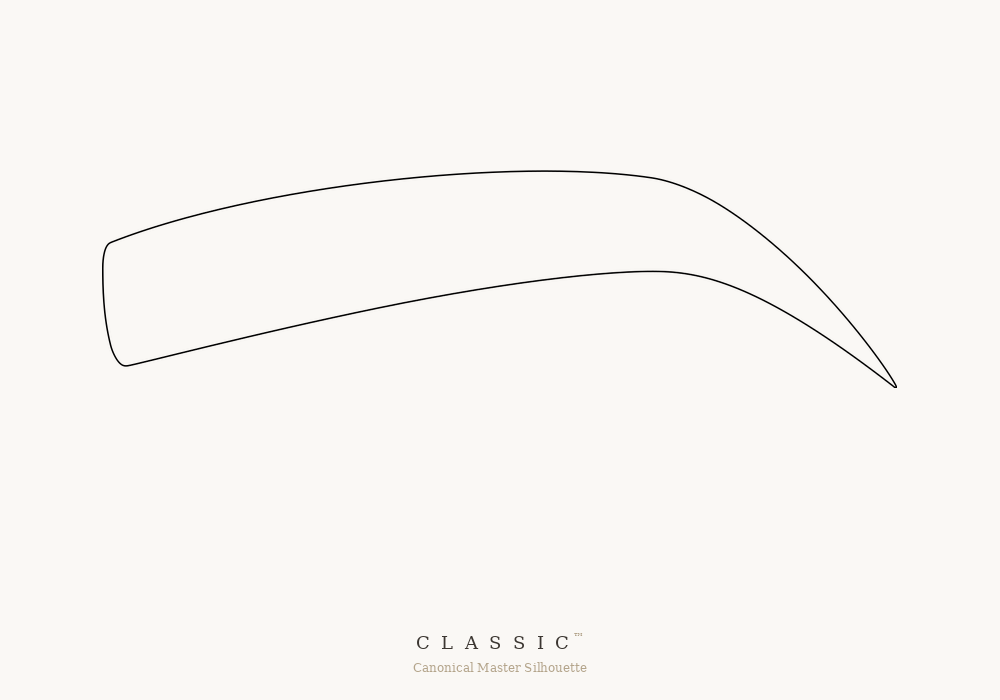
Model Overview
The Classic model functions as the structural reference point within the VELONÉ system. It is not a starting style to be outgrown, nor a default applied when alternatives seem unsuitable. It is a deliberate architecture—one built on principles of neutrality, proportion, and restraint that serve as the foundation from which all other models derive their logic.
To understand the Classic model correctly, it must be recognised as an intentional discipline rather than an absence of style. Neutrality, in this context, does not mean simplicity. It means that every element—stroke direction, density placement, taper behaviour—has been calibrated to produce a result that reads as structurally sound without drawing attention to any single feature. The Classic brow does not announce itself. It resolves.
Practitioners who dismiss Classic as "basic" or "safe" misunderstand its function. The model provides the structural grammar from which all stylistic sentences are constructed. Without fluency in Classic logic, more expressive models become unmoored—technically achievable but diagnostically arbitrary.
Visual & Flow Philosophy
The Classic silhouette is characterised by controlled parallelism. Stroke direction through the bulb and body zones maintains a consistent angle relationship—strokes do not converge toward the arch or diverge toward the tail. This parallel behaviour produces visual stability. The eye moves across the brow without encountering directional tension.
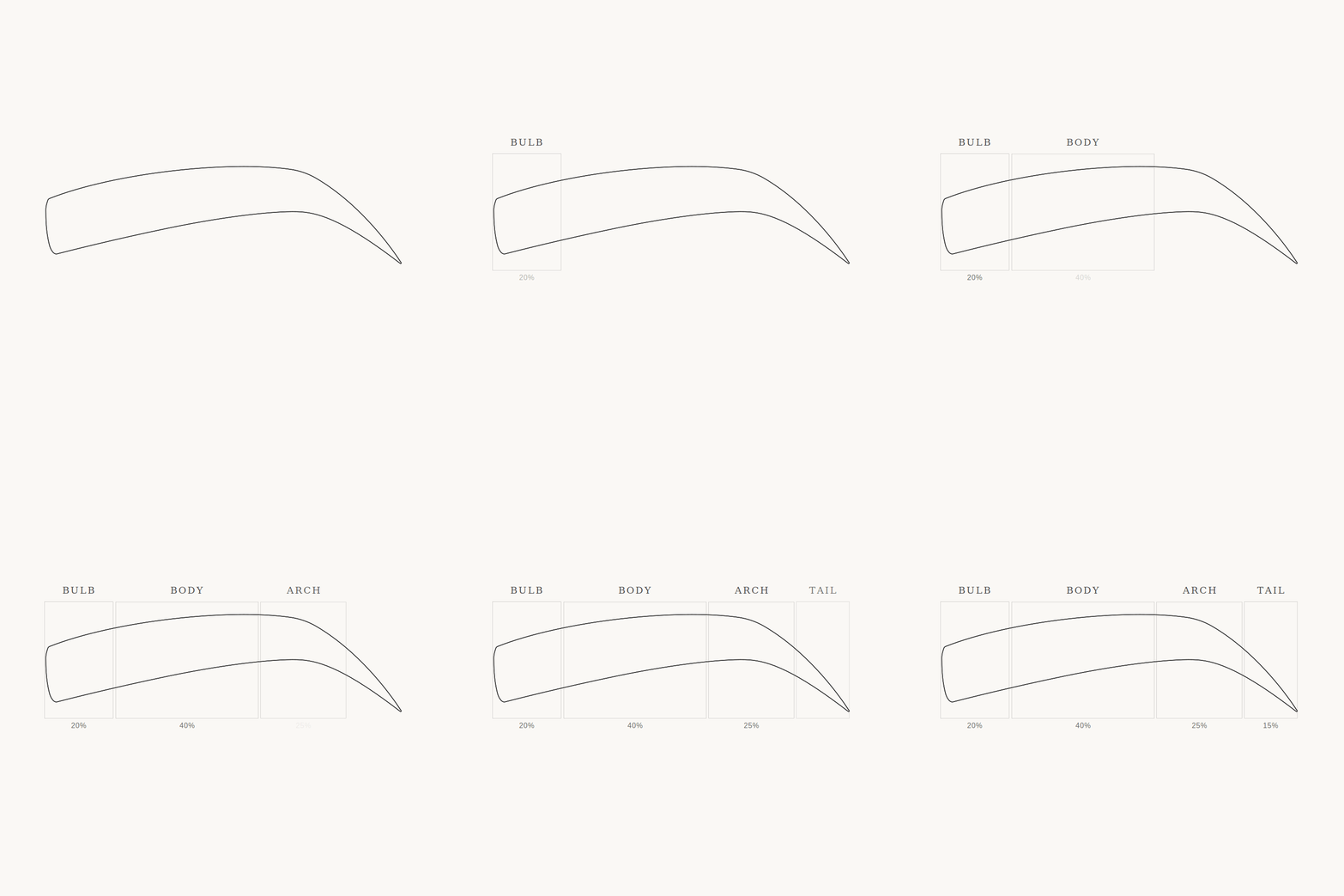
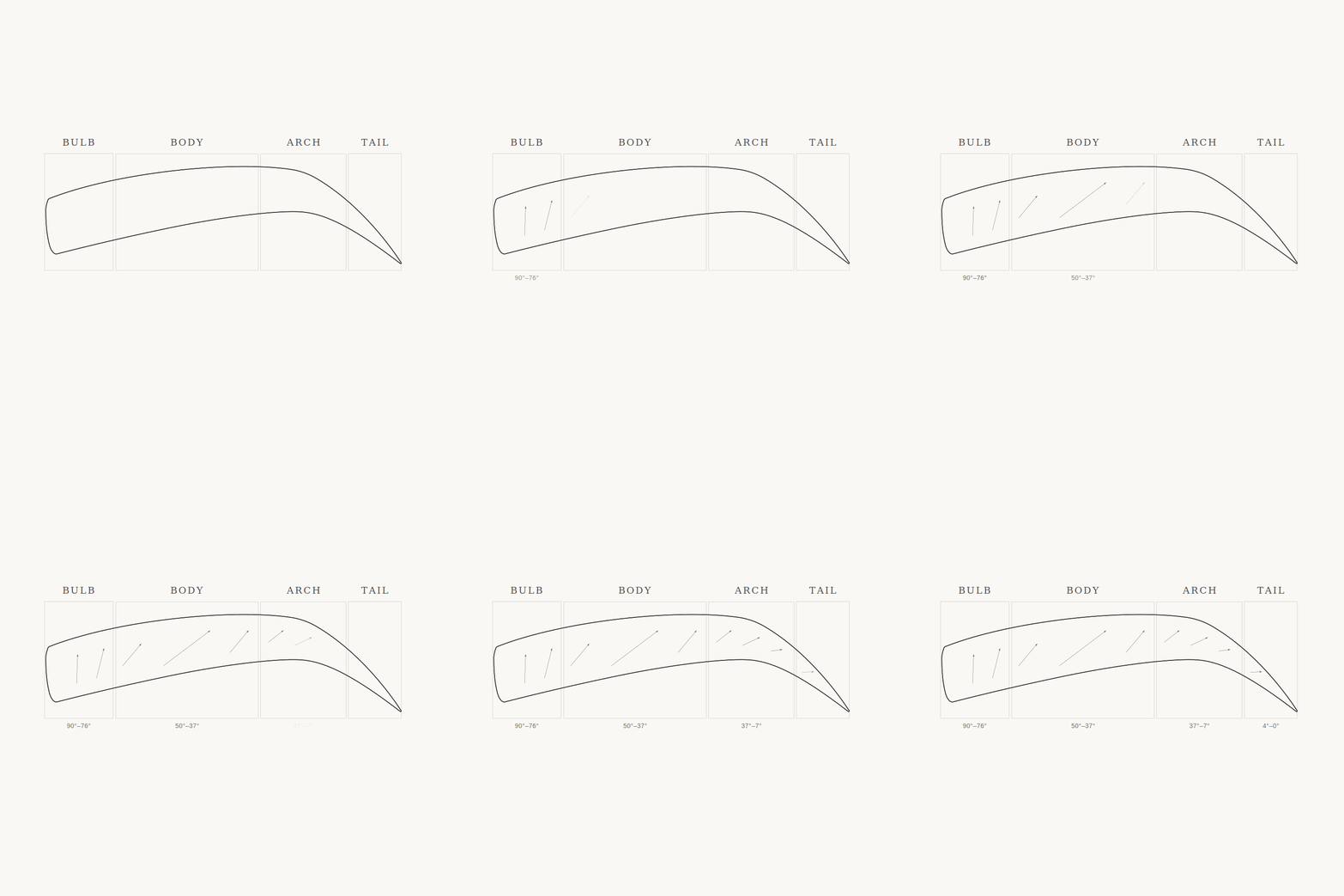
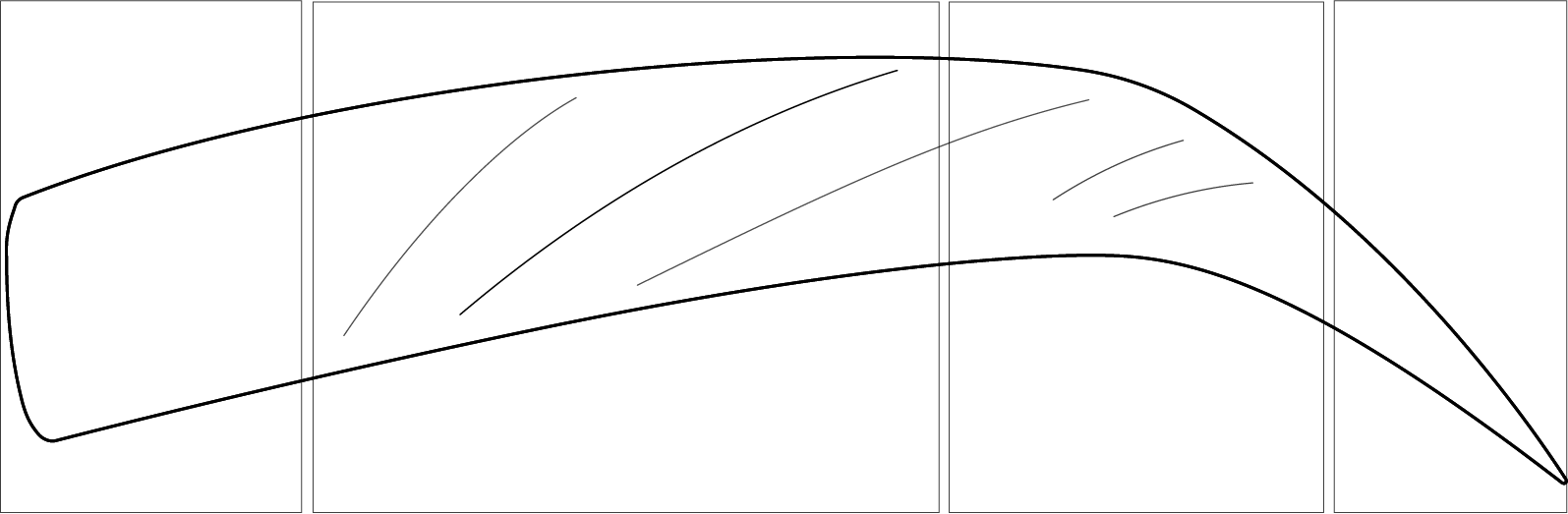
The arch zone in Classic execution is not an event; it is a transition. There is no peak, no apex that commands attention. Instead, the brow shifts from the relative verticality of the bulb through the horizontal emphasis of the body, arriving at a gentle resolution as it enters the tail. The transition reads as natural rather than constructed.
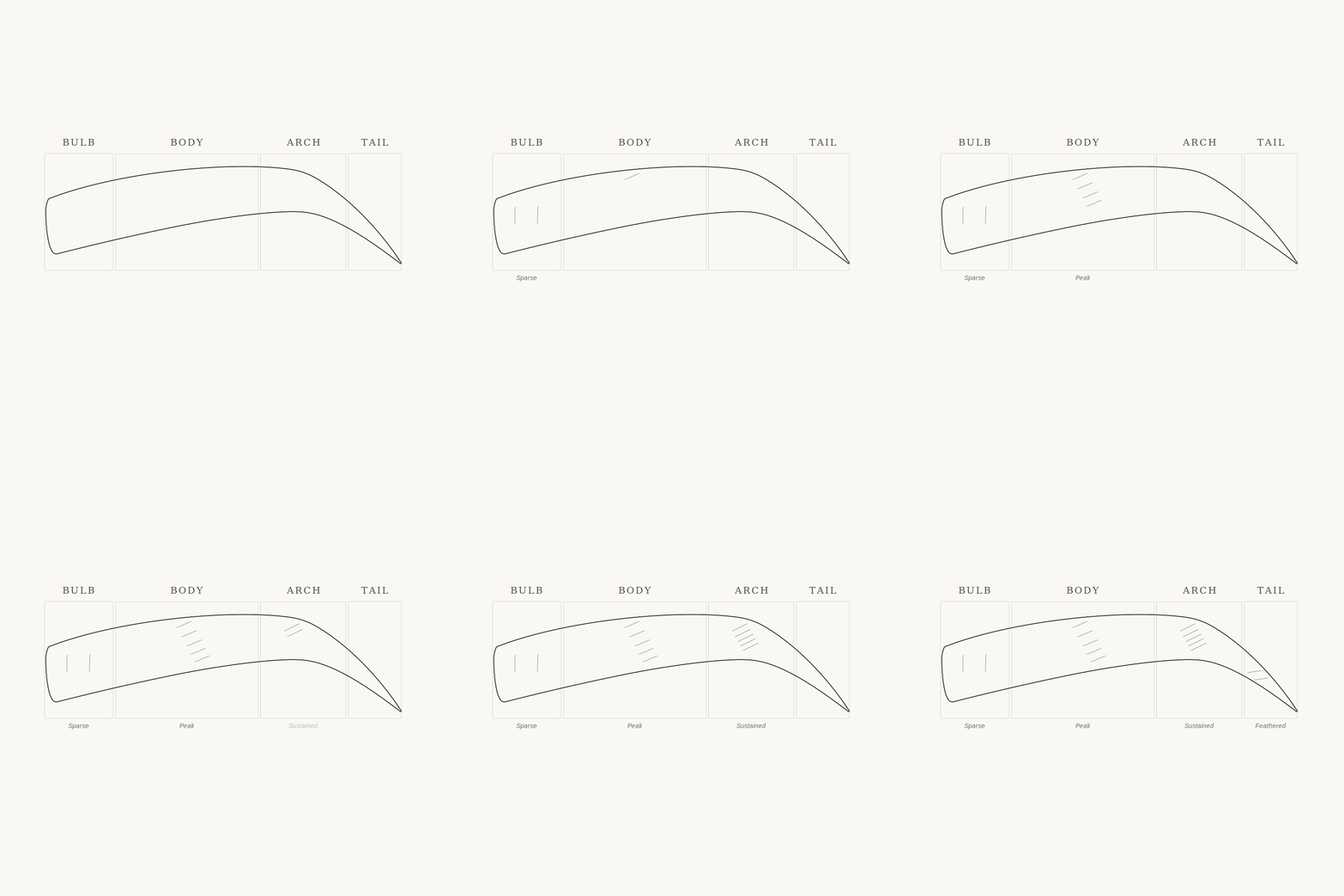
Density in the Classic model is distributed evenly. There is no concentration at the bulb, no deliberate sparsity through the body, no dramatic reduction at the tail. The brow carries its weight uniformly, resolving toward the lateral terminus with gradual, unremarkable reduction.
When the Model Works Best
Proportionally Balanced Faces
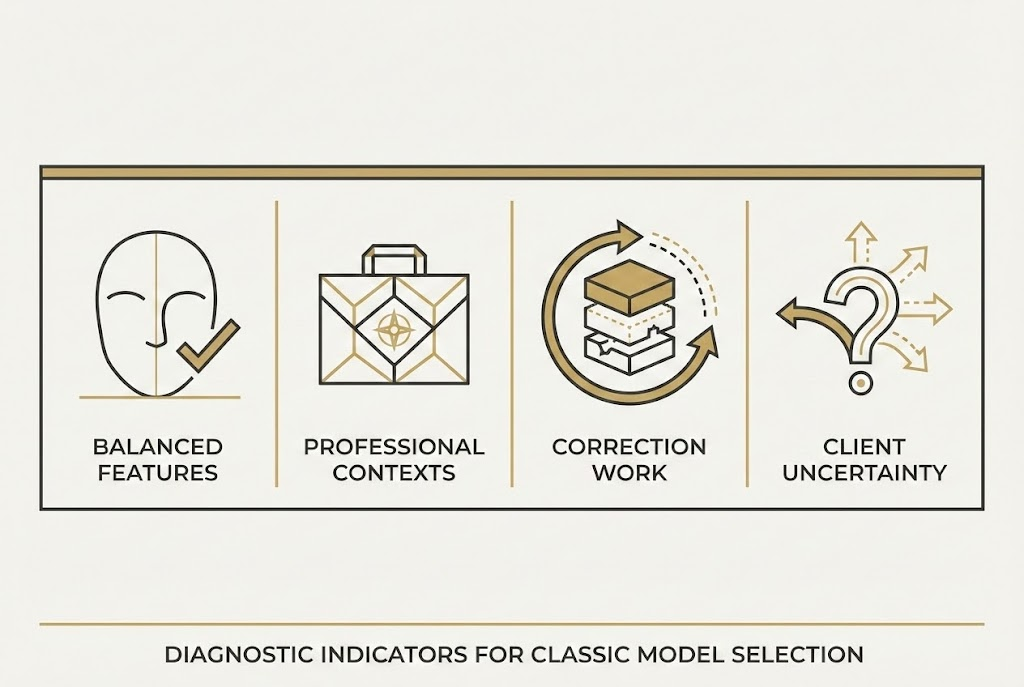
The Classic model is diagnostically indicated when facial proportions fall within conventional ranges. Clients whose facial zones are reasonably balanced—neither elongated nor compressed—can receive Classic execution without requiring compensatory adjustment. The model's neutrality allows the face to present on its own terms.
Professional Contexts
The Classic model serves clients who require a brow that performs consistently across varied settings. Professional environments, frequent photography, and situations demanding visual stability all favour Classic execution. The result reads as correct in diverse lighting and from multiple angles, without requiring grooming intervention or makeup adjustment.
Correction Work
The Classic model also functions as the preferred framework for correction work. When addressing previous brow work that has healed unevenly, faded asymmetrically, or been executed with excessive stylisation, the Classic structure provides a stable foundation for rebuilding. Its neutrality allows the practitioner to re-establish proportion before introducing—if appropriate—any stylised elements in subsequent sessions.
Uncertainty
Finally, Classic execution suits clients who are uncertain of their preferences. Because the model avoids strong directional or density statements, it allows the client to live with the result before committing to more defined styles. It is a structurally complete outcome that does not foreclose future refinement.
How the Model Is Worn
In daily wear, the Classic brow presents as quietly integrated. It does not read as a feature that has been "done"—it reads as a feature that is simply correct. This distinction is central to understanding how Classic execution differs from more stylised approaches.
Density perception in the Classic model is moderate and even. There is sufficient pigment presence to define the brow without creating heaviness. The visual weight is distributed across zones rather than concentrated at any single point. Clients perceive the brow as full but natural—present without being prominent.
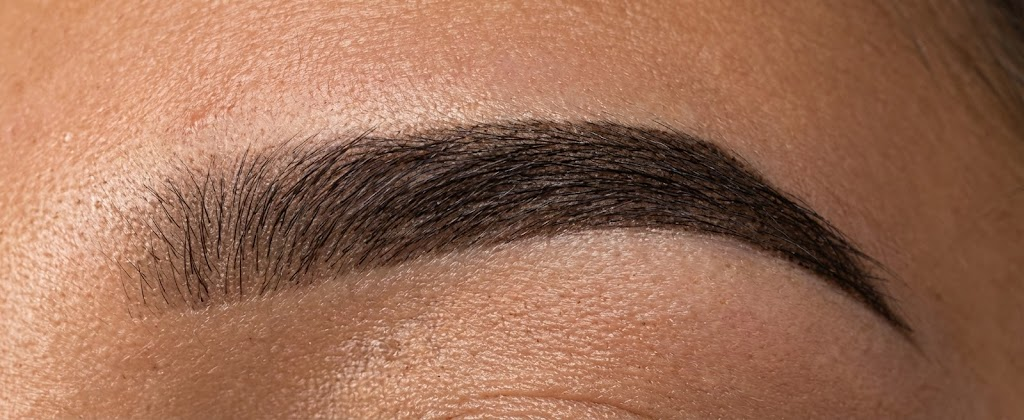
Longevity is a defining characteristic. Because Classic execution avoids extremes—in density, in directional intensity, in contrast—it ages predictably. Fading occurs gradually and evenly. The structure does not collapse into patchiness or develop disproportionate light zones. Over time, the brow softens without losing its architectural integrity.
This is why Classic work often appears "invisible" in the best sense. It does not invite attention to the intervention. It invites attention to the face.
Expression Behaviour
The Classic model demonstrates remarkable stability under facial movement. Because the architecture avoids dramatic directional tension or concentrated density points, the brow maintains its structural integrity whether the face is at rest, raised in surprise, or furrowed in concentration.
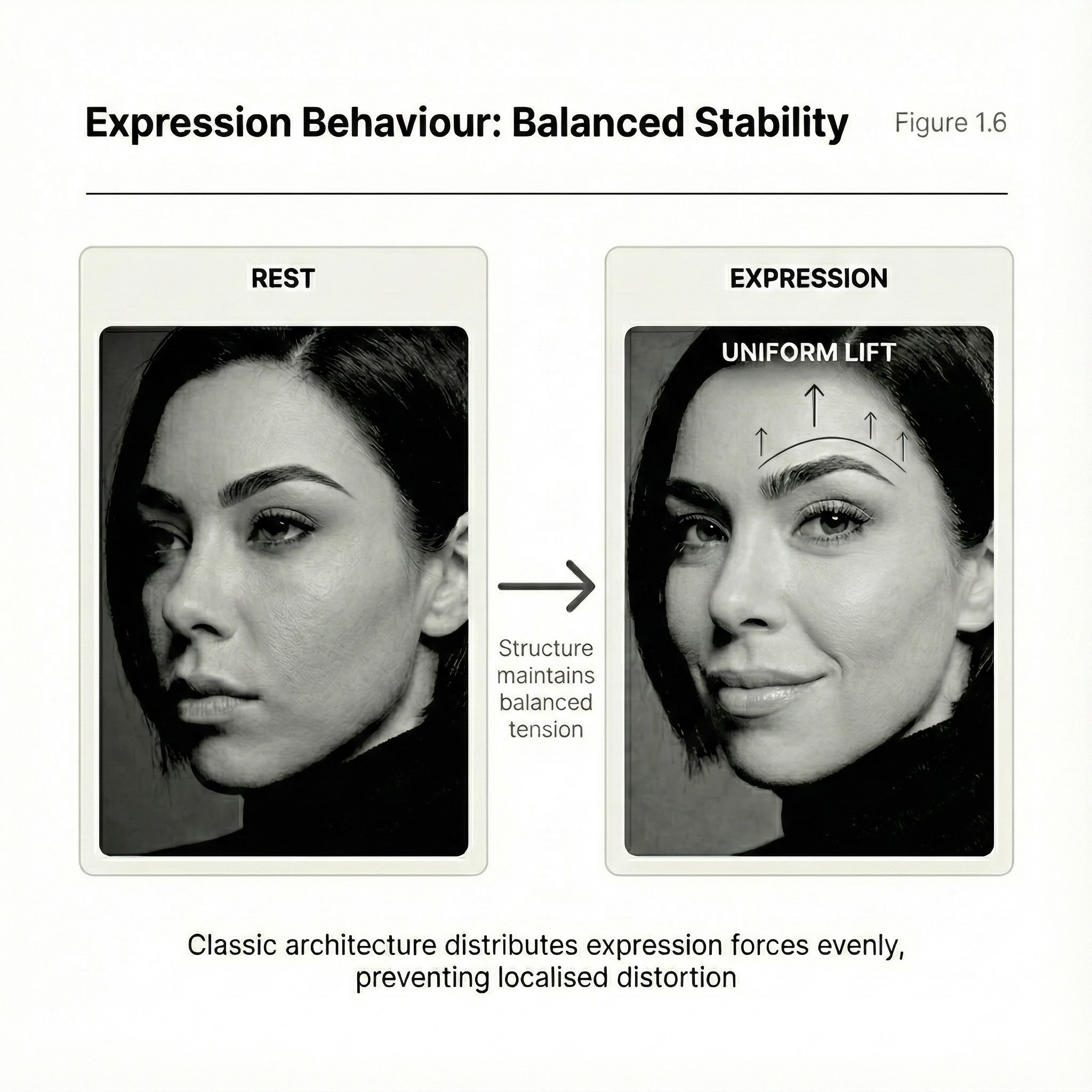
When the brow elevates, the parallel stroke pattern lifts uniformly. There is no apex that sharpens disproportionately, no bulb that compresses awkwardly. The brow simply rises, maintaining its proportional relationships. When the brow furrows, the even density distribution prevents bunching or visual collapse. The strokes compress gently without creating dark concentrations.
This behavioural stability is why Classic execution suits clients whose professional or social contexts involve frequent expression variation. The brow performs consistently across emotional states, never appearing "wrong" in candid photographs or animated conversation.
The Four Classic References
The references described below are not separate styles or variations of the Classic brow. They are diagnostic calibration points within a single canonical Classic model. Their purpose is to help the technician adjust execution logic in response to anatomy, density, and facial context, while remaining inside Classic constraints. They do not expand aesthetic choice and should not be treated as interchangeable looks.
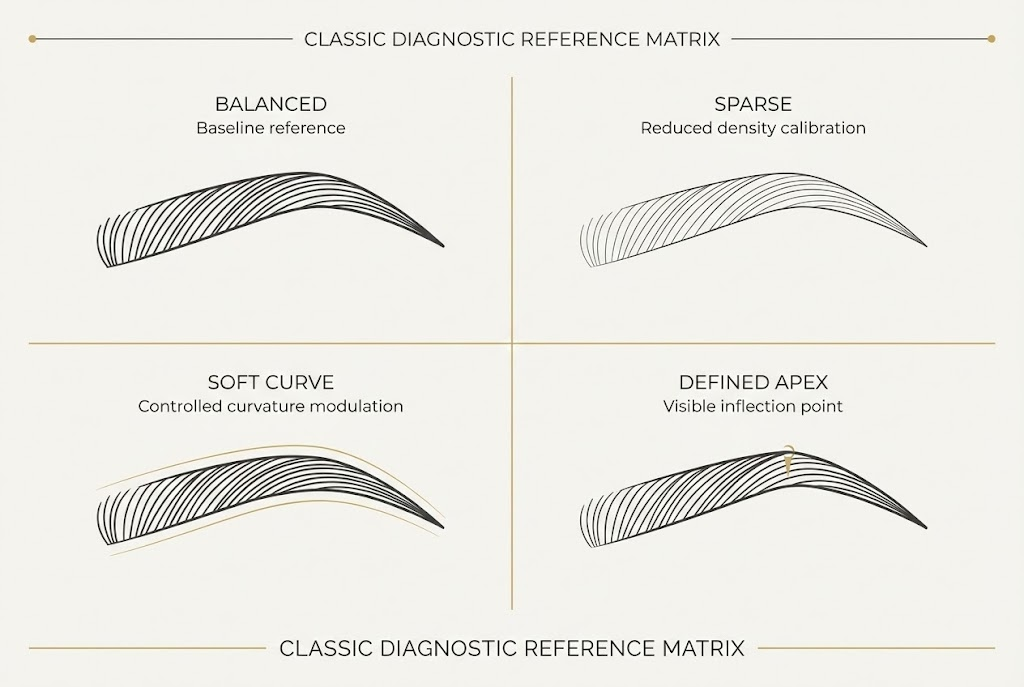
Classic — Balanced
Serves as the baseline reference. It represents the model in its most neutral form: even density distribution, controlled parallel flow, restrained arch resolution, and clean taper. When no diagnostic factor indicates otherwise, Classic — Balanced is the appropriate selection. It is the standard against which the other three references are understood.
Classic — Sparse
Addresses contexts requiring reduced density. This may be indicated by client anatomy—fine skin texture, minimal natural brow hair, or orbital structures that read as heavy when density is standard. It may also be indicated by client lifestyle or preference for a softer, less defined result. Classic — Sparse maintains the same proportional logic and flow behaviour as Classic — Balanced; only the density calibration differs.
Classic — Soft Curve
Introduces subtle curvature modulation. Where Classic — Balanced maintains strict linearity through the body, Classic — Soft Curve permits a gentle, controlled arc that follows the natural brow bone more closely. This reference is appropriate when client anatomy features a curved orbital ridge or when the face benefits from softened horizontal energy.
Classic — Defined Apex
Provides controlled arch emphasis. The apex gains presence without sharpness—it becomes a visible inflection point rather than a subtle transition. This reference suits clients whose facial structure benefits from gentle vertical lift at the arch or whose features read as flat without moderate apex definition.
Selection among these four diagnostic reference positions is a clinical decision. The practitioner assesses facial anatomy, skin characteristics, existing brow behaviour, and client context, then identifies which reference provides the appropriate structural response. This is not a menu. It is a framework for precision.
Execution Within Classic Parameters
Beyond the four canonical diagnostic reference positions, Classic execution permits minor conditional adjustments that do not warrant distinct model status. These adjustments are execution notes—guidance for calibrating work within the boundaries of the Classic model based on individual client factors.
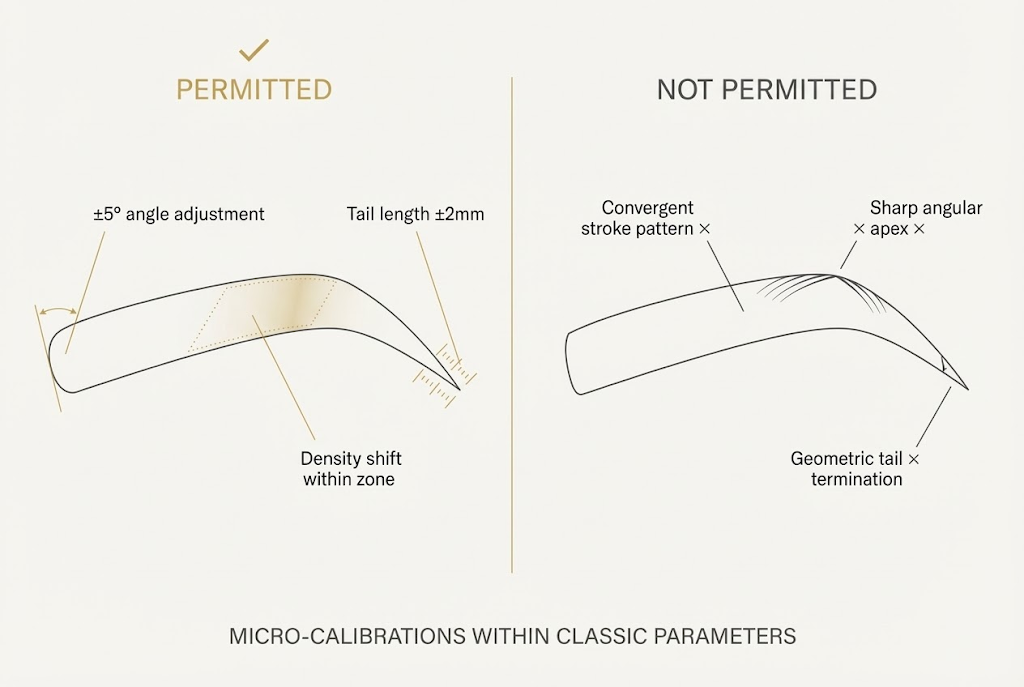
Micro-directional calibration may be applied when client anatomy suggests slightly more vertical or horizontal stroke energy. A client with a low-set brow bone may benefit from marginally increased vertical lift at the bulb; a client with prominent orbital structure may require flattened stroke angles to avoid visual conflict.
Tail resolution may be adjusted for length and termination behaviour. Some client anatomies suit a tail that extends further toward the temple; others require earlier termination to maintain facial proportion.
What remains non-negotiable across all Classic execution is the governing logic. Parallel flow is maintained. Silhouette discipline is preserved. Convergence is not introduced. Dramatic arch peaks, aggressive lifts, and graphic contrast belong to other models.
Transitioning from Classic to Other Models
The Classic model serves as the departure point for all other models within the system. Understanding how to transition from Classic execution to alternative models requires clarity about what must be intentionally altered and what must remain grounded in foundational logic.
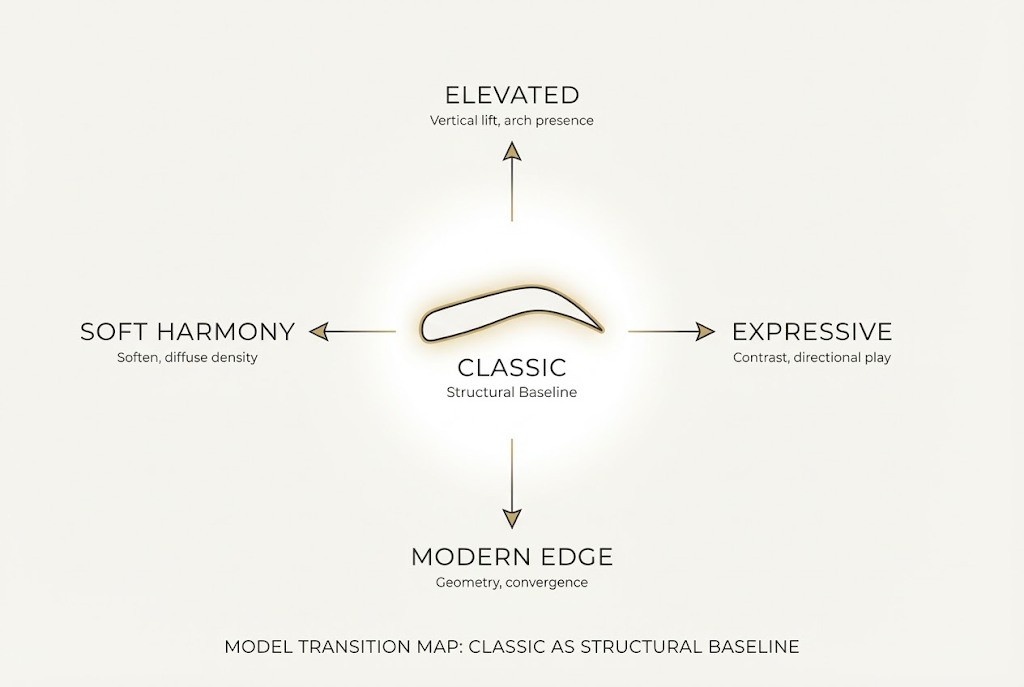
Transitioning to Soft Harmony
Involves amplifying the brow's integrative quality. Density may be reduced beyond even the Classic — Sparse reference. Stroke visibility may be softened further. The goal is to move from "correct" to "gentle"—the brow recedes further into the face, supporting features without structural assertion.
Transitioning to Elevated
Requires introducing controlled vertical energy. The bulb lift increases beyond what Classic — Balanced or Classic — Defined Apex permit. The arch gains definition—not sharpness, but presence that actively lifts the face rather than simply framing it.
Transitioning to Expressive
Involves permitting directional play and contrast. Stroke patterns may exhibit more variety in angle. Density distribution may become less uniform, with intentional emphasis points. The brow gains personality—it becomes a feature that communicates rather than one that resolves.
Transitioning to Modern Edge
Requires the most significant departure. Convergence is introduced. Contrast is heightened. The tail may resolve with graphic precision rather than soft taper. This model permits sharpness that Classic execution explicitly avoids.
In all transitions, the Classic model provides the stable reference. The practitioner does not abandon Classic logic when moving to another model; they modify it with intention. This is why mastery of Classic execution is prerequisite to competent work in any other model.
Classic
Structural baseline

Example images coming soon.