Section 1: Foundations & Terminology
1.1 The Purpose of Standardised Language
Professional communication requires precision. When two practitioners discuss brow architecture, ambiguity creates error. The VELONÉ terminology system eliminates this risk by establishing fixed definitions for every structural element, directional concept, and technical parameter.
These terms must be learned, internalised, and used consistently. They form the shared language of the VELONÉ method and are required for accurate documentation, peer consultation, and client communication.
1.2 Anatomical Landmarks
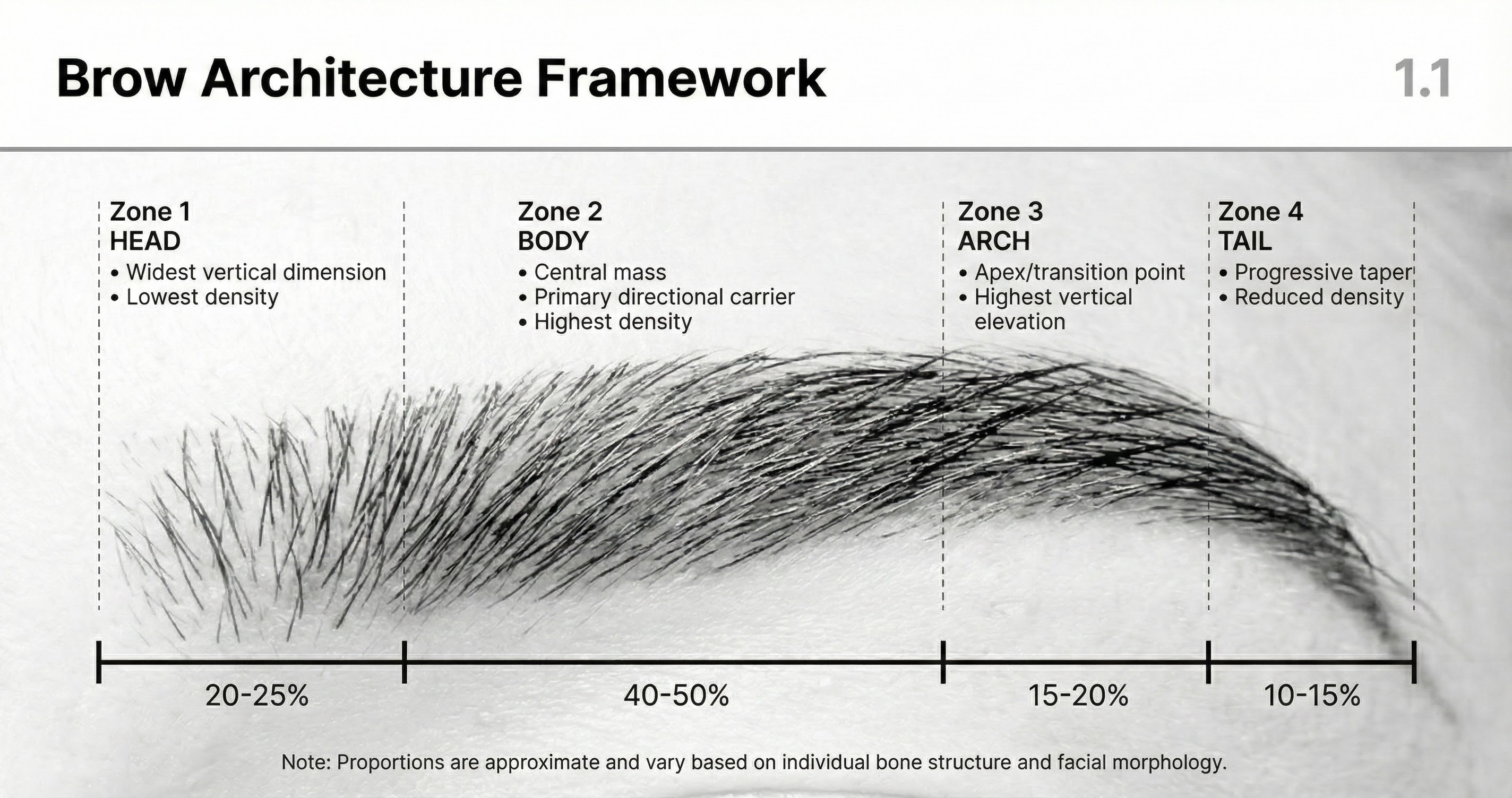
Brow Architecture Framework
Purpose: Establish the brow as a system, not a shape
A frontal view showing the complete brow unit divided into four distinct zones. Zone 1 (Head) occupies the medial 15-20%, characterised by maximum vertical height and lowest density. Zone 2 (Body) spans the central 50-60%, carrying the primary directional flow and highest density. The Arch marks the apex transition point. Zone 3 (Tail) extends laterally with progressive taper and reduced density toward the terminus.
The Brow Unit
The brow unit refers to the complete visible brow structure, encompassing all hair-bearing and skin-adjacent tissue from the medial origin to the lateral terminus. It is the macro-level canvas upon which all architectural decisions are made.
The Head (Zone 1)
The head is the innermost section of the brow, originating at the medial boundary and extending toward the body. It is characterised by the widest vertical dimension and the lowest stroke density. The head sets the initial directional tone for the entire brow and is the primary zone for establishing flow philosophy.
In most faces, the head occupies approximately 15–20% of total brow length. Its inferior and superior boundaries determine the vertical height that will taper through subsequent zones.
The Body (Zone 2)
The body constitutes the central mass of the brow, extending from the head through to the apex. It is the zone of greatest density and the primary carrier of directional flow. Stroke alignment in the body determines the perceived rhythm and movement of the brow.
The body represents approximately 50–60% of total brow length in most architectural configurations.
The Arch / Apex (Zone 2–3 Transition)
The arch (also referred to as the apex) marks the point of highest vertical elevation within the brow silhouette. It is both a positional landmark and a transitional moment: the point at which body direction resolves into tail direction.
Apex placement is a defining factor in style expression:
- Lateral apex positioning creates lift and modernity
- Medial positioning softens and classicises
The apex is not a point to be created arbitrarily; it emerges from the interaction of bone structure, brow mapping, and style intention.
The Tail (Zone 3)
The tail is the outermost section of the brow, extending from the apex to the lateral terminus. It is characterised by progressive narrowing (taper), reduced density, and the final resolution of directional flow.
Tail length, thickness, and endpoint elevation are critical to overall expression:
- The standard rule: the tail endpoint should sit at or slightly above the level of the brow head. A tail that drops below this line creates a drooping effect
- A tail terminating too high may appear incomplete
1.3 Directional Flow Terminology
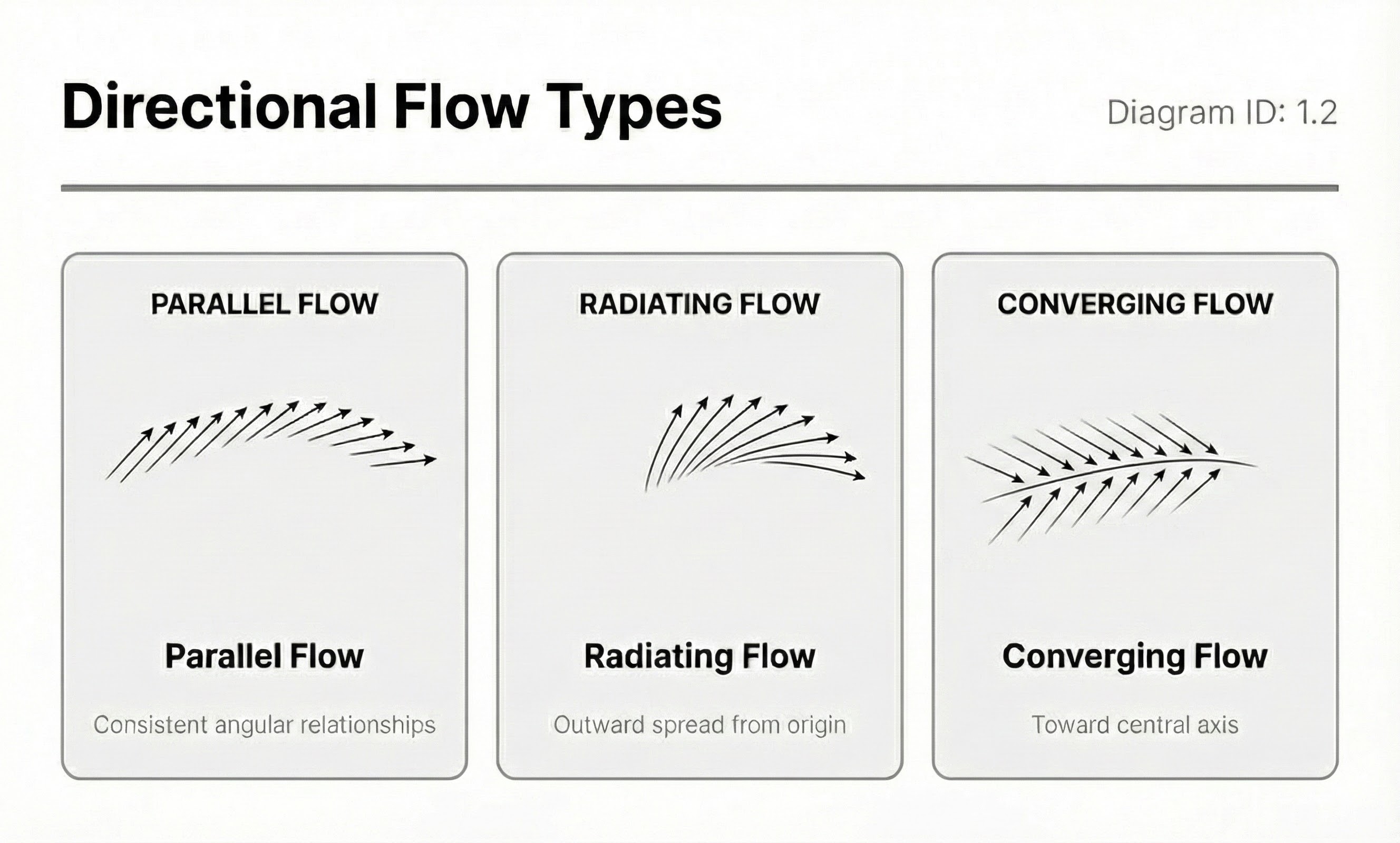
Brow Axis and Directional Flow
Purpose: Visualise directional movement across zones
Three brow illustrations demonstrating the primary flow types. Parallel flow shows strokes maintaining consistent angular relationships throughout—the defining characteristic of the Classic family. Radiating flow depicts strokes spreading outward from a central arc, ranging from soft (Soft Harmony) to sharp (Expressive). Converging flow illustrates strokes angling toward a shared vanishing point, creating structural tension characteristic of Elevated and Modern Edge families.
Flow
Flow refers to the collective directional movement of strokes within and across brow zones. It is the macro-level expression of how individual stroke angles combine to create perceived motion. Flow is the single most important factor distinguishing one style family from another.
Parallel Flow
In parallel flow, strokes maintain consistent angular relationships throughout the brow. There is no convergence or divergence; each stroke echoes the trajectory of its neighbours.
Produces: Rhythm, calm, and structural harmony
Defining characteristic of: The Classic family
Radiating Flow
Radiating flow describes strokes that originate from a perceived central point (or arc) and spread outward, creating a fan-like effect.
Intensity range: Soft (Soft Harmony) to sharp (Expressive)
Produces: Energy, movement, and dimension
Converging Flow
Converging flow describes strokes that angle toward a shared vanishing point or axis, creating a sense of lift or narrowing. Upper strokes angle downward; lower strokes angle upward.
Produces: Structural tension and modernity
Defining characteristic of: The Elevated and Modern Edge families
1.4 Density Terminology
Density
Density refers to the quantity of strokes per unit area within a given zone. It is measured relative to the zone's role within the brow architecture, not as an absolute count.
Low Density
A low-density zone contains fewer strokes with greater visible spacing between them.
Produces: An airy, soft, or natural appearance
Application: The head is always the lowest-density zone in any brow configuration
Moderate Density
Moderate density represents the baseline for the body zone in most style families. Strokes are evenly spaced with consistent rhythm.
Produces: A balanced, refined appearance without heaviness
High Density
High-density zones contain closely spaced strokes with minimal visible skin between them.
Produces: Boldness, definition, and structural weight
Application: Used selectively, typically in the mid-body, to create focal impact
1.5 Pressure & Stroke Terminology
Pressure Gradient
The pressure gradient describes the variation in applied pressure across a single stroke from entry to exit. Controlled pressure gradients produce natural-looking strokes that mimic the appearance of real hair: finer at the ends, fuller at the centre.
Tail Pressure
Tail pressure refers specifically to the pressure applied when entering and exiting a stroke:
- Reduced tail pressure at both ends creates tapered, hair-like strokes
- Consistent tail pressure produces more graphic, defined strokes
Stroke Weight
Stroke weight is the perceived thickness of an individual stroke. It is determined by a combination of needle configuration, pressure, and velocity.
- Heavier strokes contribute density and boldness
- Lighter strokes contribute softness and naturalism
1.6 Mapping Terminology
Landmark Point
A landmark point is a fixed positional reference established during the mapping phase. Landmark points define the structural boundaries of the brow and are determined by facial geometry, not by existing hair growth.
The 7-Point Protocol
The VELONÉ 7-Point Protocol is the standardised mapping system used to establish all critical landmarks prior to stroke work. It identifies seven specific positions that govern brow placement, proportion, and symmetry.
Baseline
The baseline is the horizontal reference line connecting the inferior boundary of the head to the inferior boundary of the tail endpoint. It serves as the foundational axis for assessing lift, drop, and overall brow trajectory.
Apex Placement Ratio
The apex placement ratio describes the horizontal position of the arch relative to total brow length.
Example: A ratio of 65% indicates the apex occurs at 65% of the distance from head origin to tail terminus.
Standard range: 60–70%, with variation based on style family and facial structure
1.7 Zone Reference System
For precision communication, the VELONÉ system divides the brow into three primary zones:
| Zone | Region | Primary Characteristics |
|---|---|---|
| Zone 1 | Head | Widest vertical height, lowest density, flow origin |
| Zone 2 | Body | Central mass, highest density, primary directional carrier |
| Zone 3 | Tail | Progressive taper, reduced density, flow resolution |
These zone designations are used throughout all VELONÉ documentation, training materials, and professional communication.