Section App. 13: Healing Variables, Retention Mapping & Long-Term Outcomes
Definition
Healing variables are the factors that determine how a procedure result evolves from the moment the tool leaves the skin to the fully stabilised outcome at eight to twelve weeks. Retention mapping is the practice of systematically documenting how pigment holds across different zones, skin types, and technique approaches to build predictive accuracy over time.
The procedure is not the product. The healed result is the product.Everything that happens between the final stroke and the six-week follow-up determines whether your work succeeds or fails. Understanding and managing these variables is what separates practitioners who produce reliably excellent healed results from those who produce excellent fresh results that disappoint at follow-up.
Theory
Healing Phases in Detail
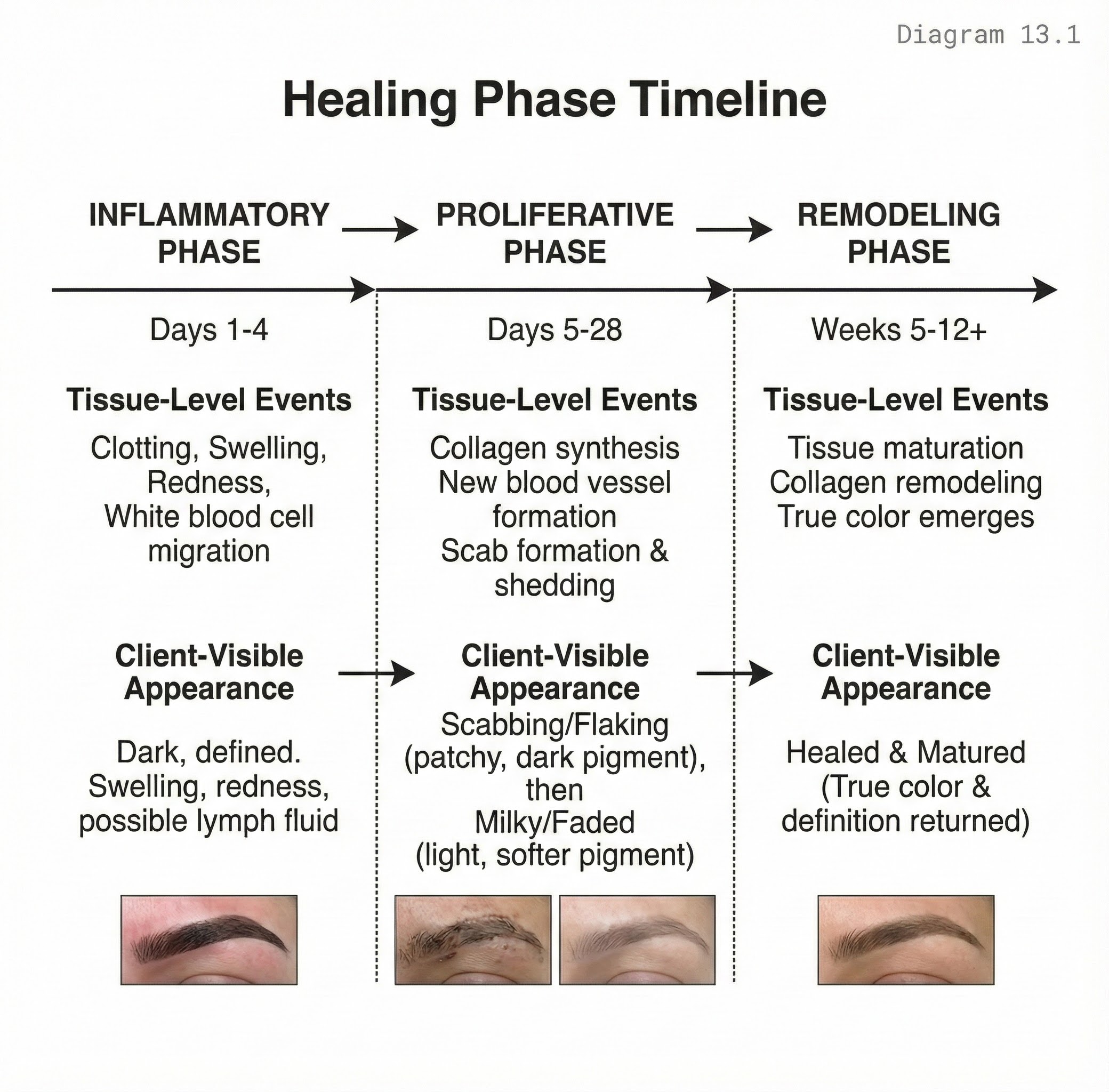
The immediate post-procedure period (hours 0 to 24) produces the sharpest, most saturated appearance the brow will ever have. Surface pigment, lymphatic fluid, and mild swelling combine to create a result that is typically 40 to 60 percent more intense than the healed outcome. Clients who have not been properly educated will often love this stage, which creates a dangerous expectation anchor.
Days 2 to 5 bring the onset of scabbing or flaking as the epidermis regenerates. The visual appearance deteriorates significantly. Pigment appears to be lifting off with the scabs, and clients commonly report that their brows are "disappearing." This is the peak anxiety window and the most common trigger for panicked calls and messages.
Days 7 to 14 produce what practitioners call the "ghosting phase": the regenerated epidermis sits over the pigment layer and creates a milky, washed-out appearance. Strokes that were crisp and dark now look faded and unclear. This phase resolves as the new skin matures and becomes more transparent, but clients who were not warned may conclude the procedure has failed.
Weeks 4 to 8 bring the true healed colour. The epidermis has stabilised, pigment that was going to be expelled has been expelled, and what remains is the actual result. This is when the practitioner can accurately assess retention and plan any touch-up work.
Healing Phase Timeline
Purpose: Show appearance changes through healing
A comprehensive timeline showing appearance at key stages: fresh, day 3, day 7, day 14, day 30, day 60, and day 90. Visual appearance and tissue state are noted at each point.
Variable Influence on Outcomes
Healing outcomes are determined by the interaction of practitioner-controlled variables (technique, depth, pigment selection, saturation level) and client-controlled variables (aftercare compliance, sun exposure, skincare products, immune response). The practitioner can optimise their variables but cannot control the client's. This is why education and realistic expectation-setting are as important as technical skill.
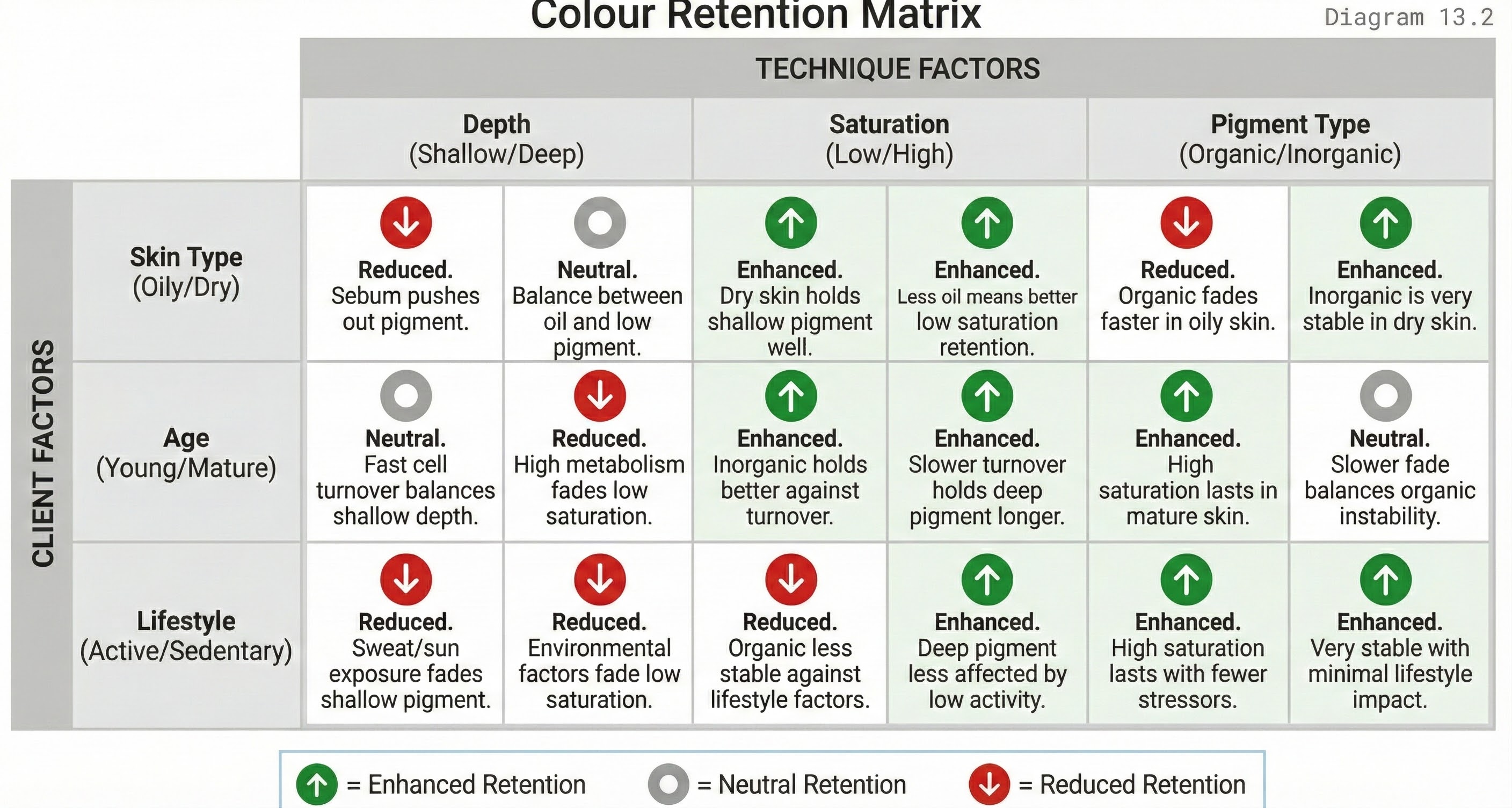
Skin type creates the largest predictable variation. Oily skin typically loses 30 to 50 percent more pigment during healing than dry skin. Strokes on oily skin heal softer, wider, and with less definition. Mature skin with reduced collagen heals differently again: pigment may retain well in terms of colour intensity but strokes lose crispness as the less-structured dermis allows slight migration. Fitzpatrick type affects colour shift: higher Fitzpatrick types are more prone to post-inflammatory hyperpigmentation, which can alter the apparent colour of healed work.
Retention Factors Matrix
Purpose: Systematise variables affecting retention
A matrix with client factors (skin type, age, lifestyle, health) on one axis and technique factors (depth, saturation, pigment choice) on the other. Cell entries indicate impact on retention.
Retention Mapping
Retention mapping transforms anecdotal experience into systematic knowledge. For each client, document the skin assessment, technique parameters, immediate post-procedure photograph, and healed result photograph at six weeks. Over time, patterns emerge: specific skin types consistently lose pigment in specific zones; certain blade configurations retain better on certain tissue types; particular aftercare protocols produce measurably different outcomes.
The value of retention mapping compounds. After fifty documented cases, the practitioner can predict with reasonable accuracy what a given skin type will look like at six weeks. After two hundred cases, the predictions become precise enough to inform pigment saturation decisions: if this skin type typically loses 40 percent, oversaturate by 40 percent at the point of application.
Methodology
Pre-Procedure Healing Assessment
Before the procedure, assess factors that will affect healing. Check for active skincare products that affect skin turnover (retinoids, AHAs, BHAs) and advise discontinuation two weeks prior. Assess the client's general health, medications (blood thinners affect bleeding and therefore pigment retention), and stress levels (cortisol affects inflammatory response). Document sun exposure habits and outdoor occupation, as these affect long-term fade rates.
Healing Monitoring
Establish a monitoring protocol: check-in at day 3 (reassure about scabbing), day 7 (reassure about ghosting), and week 6 (assess healed result and plan touch-up). Photograph at each checkpoint under consistent lighting. The day 7 check-in is the most valuable for client relationship because it occurs at peak anxiety, and a calm, knowledgeable response from the practitioner builds lasting trust.
Retention Documentation
For each completed case, create a retention record: skin type and characteristics, technique parameters used, pigment formula and brand, immediate appearance versus healed appearance, zone-by-zone retention assessment (which zones retained best, which lost most). Store these records in a format that allows comparison across cases. A simple spreadsheet tracking these variables across your client base produces more actionable insight than any textbook.
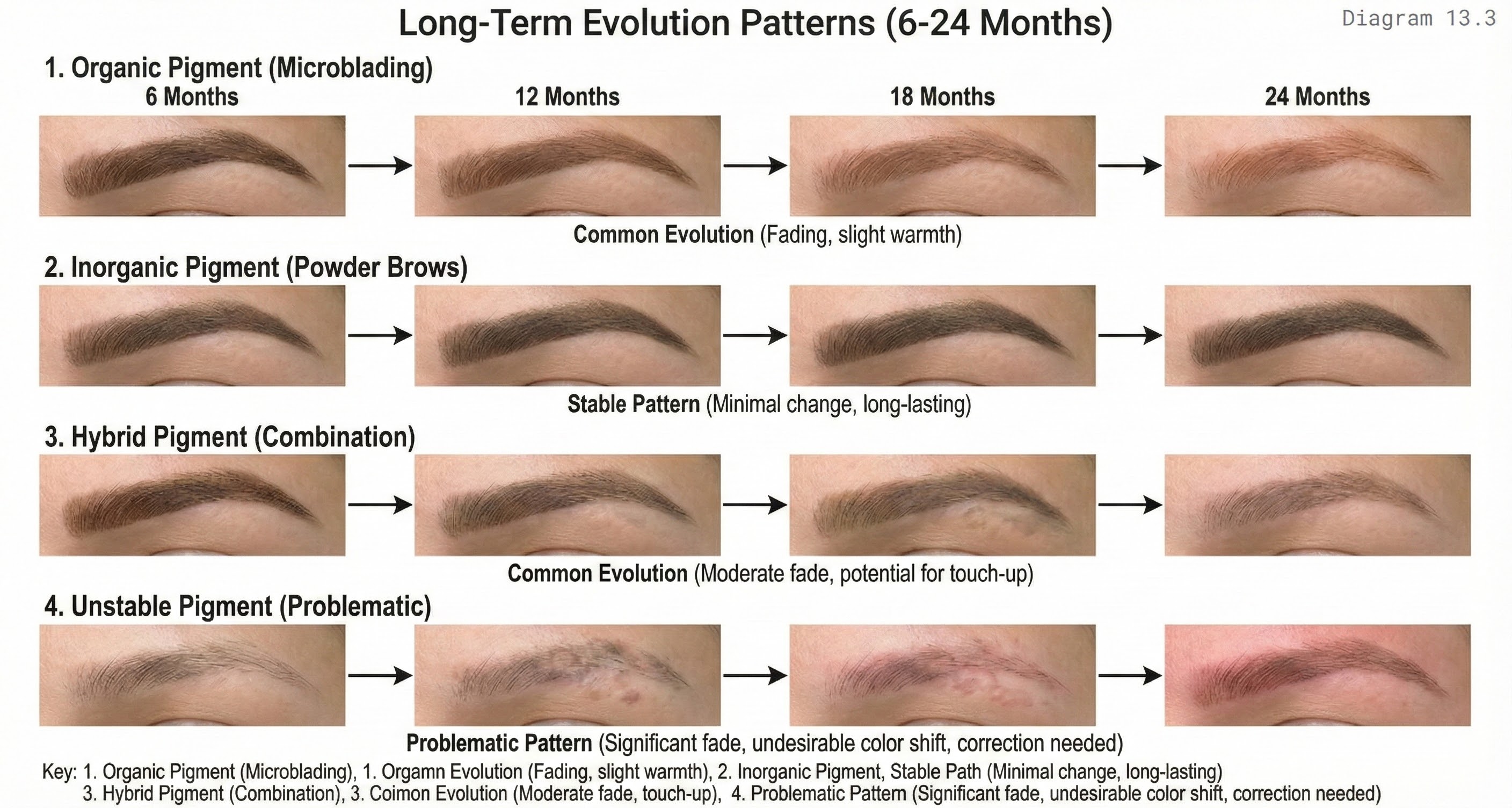
Long-Term Evolution Patterns
Purpose: Show typical fading patterns over extended time
Multiple timeline tracks showing evolution from 6 to 24 months for different scenarios: good retention, moderate fade, significant fade, and problematic evolution.
Techniques
Client Healing Education
Deliver healing education before the procedure, not after, when the client is distracted by their fresh result. Use a visual timeline showing actual healing progression photographs from previous clients (with consent). Walk through each phase explicitly: "On day three, your brows will look like this. On day seven, they will look like this. This is normal." Provide a printed or digital reference the client can consult when they are anxious at home.
Aftercare Protocol Design
Aftercare is not one-size-fits-all. Oily skin benefits from dry healing protocols that minimise moisture on the surface. Dry skin may benefit from light emollient application to prevent excessive scabbing that pulls pigment out. Sensitive skin may require modified cleaning protocols to avoid irritation. Design the aftercare protocol to match the assessed skin, and explain the reasoning to the client so they understand why their protocol may differ from what they read online.
Touch-Up Strategy
The touch-up appointment is not a correction. It is the second half of a two-session process. Frame it this way from the initial consultation: "The first session establishes the foundation. The second session, six to eight weeks later, refines and perfects." This framing prevents the client from viewing the touch-up as evidence that the first session failed.
At the touch-up, the retention map tells you exactly where to focus. Zones that retained well need minimal work. Zones that lost pigment receive targeted reinforcement. This precision approach produces better final results than a full re-application, because it addresses specific areas of need without over-working areas that have already healed well.
Professional Notes
Long-term outcomes (twelve to twenty-four months) follow predictable patterns by technique type. Hairstrokes typically fade faster than powder work because the linear wound channels have more surface area relative to pigment volume. Combination brows often develop an asymmetric fade pattern where the hairstroke component fades before the shading component, requiring the client to decide whether to refresh strokes, add shading, or accept the evolved appearance.
Colour shift is inevitable. All pigments change over time. Warm-toned pigments tend to fade warm (sometimes appearing orange or peach). Cool-toned pigments tend to fade cool (sometimes appearing grey or blue). Anticipate the shift direction during initial colour selection and bias slightly in the opposite direction. Document which pigments shift and how, building a product-specific reference.
Common Mistakes
Under-educating the client about healing. The single most common source of client dissatisfaction is not poor technique. It is poor communication about what to expect. The client who panics on day five and picks at their scabs, damaging the result, was failed by education, not by execution.
Judging results before healing is complete. Both practitioners and clients are guilty of assessing at week two or three, when the ghosting phase makes everything look faded and disappointing. This leads to premature touch-ups on incompletely healed tissue. Wait the full six to eight weeks.
Ignoring retention data. Practitioners who do not document and review their outcomes cannot improve their predictions. Each healed result is data. Practitioners who discard that data are choosing to repeat the same errors with each new client.
Expert Insights
The practitioners with the best healed results are not necessarily the ones with the best hand skills. They are the ones who select pigment, depth, and saturation based on predicted healing behaviour rather than desired immediate appearance. They over-saturate where they know retention will be lower. They under-saturate where they know retention will be higher. They adjust colour to compensate for predicted shift. This predictive approach requires the retention data that only systematic documentation provides.
Practical Application
Start a retention log if you do not have one. For every PMU client, record skin type, technique parameters, pigment used, and immediate result. At the touch-up appointment, add the healed result assessment. After twenty cases, review the data for patterns. After fifty cases, use those patterns to adjust your technique parameters for new clients with similar presentations. This is how prediction accuracy develops: not through theory, but through documented observation.