Section 5: Correction Logic & Decision Hierarchies
Definition
Correction logic encompasses the reasoning frameworks that guide decisions about when, how, and how much to correct existing brow work, natural brow characteristics, or asymmetric features. Decision hierarchies provide structured approaches to complex correction situations where multiple factors must be weighed.
At the mastery level, correction becomes a frequent concern—clients often present with previous work, and natural brows commonly require modification rather than simple enhancement.
Correction differs from initial work in important ways. The canvas is not blank; previous decisions—by nature, previous practitioners, or the client themselves—have established a starting point that constrains options. Correction logic addresses how to assess this starting point, what outcomes are achievable from it, and how to prioritise competing correction goals.
Theory
Correction theory begins with outcome categorisation. Correction scenarios present varying degrees of difficulty and varying achievable outcomes.
Outcome Categories
- Situations permitting restoration to near-ideal appearance
- Situations permitting improvement but with residual visible compromise
- Situations that may be essentially uncorrectable through available modalities
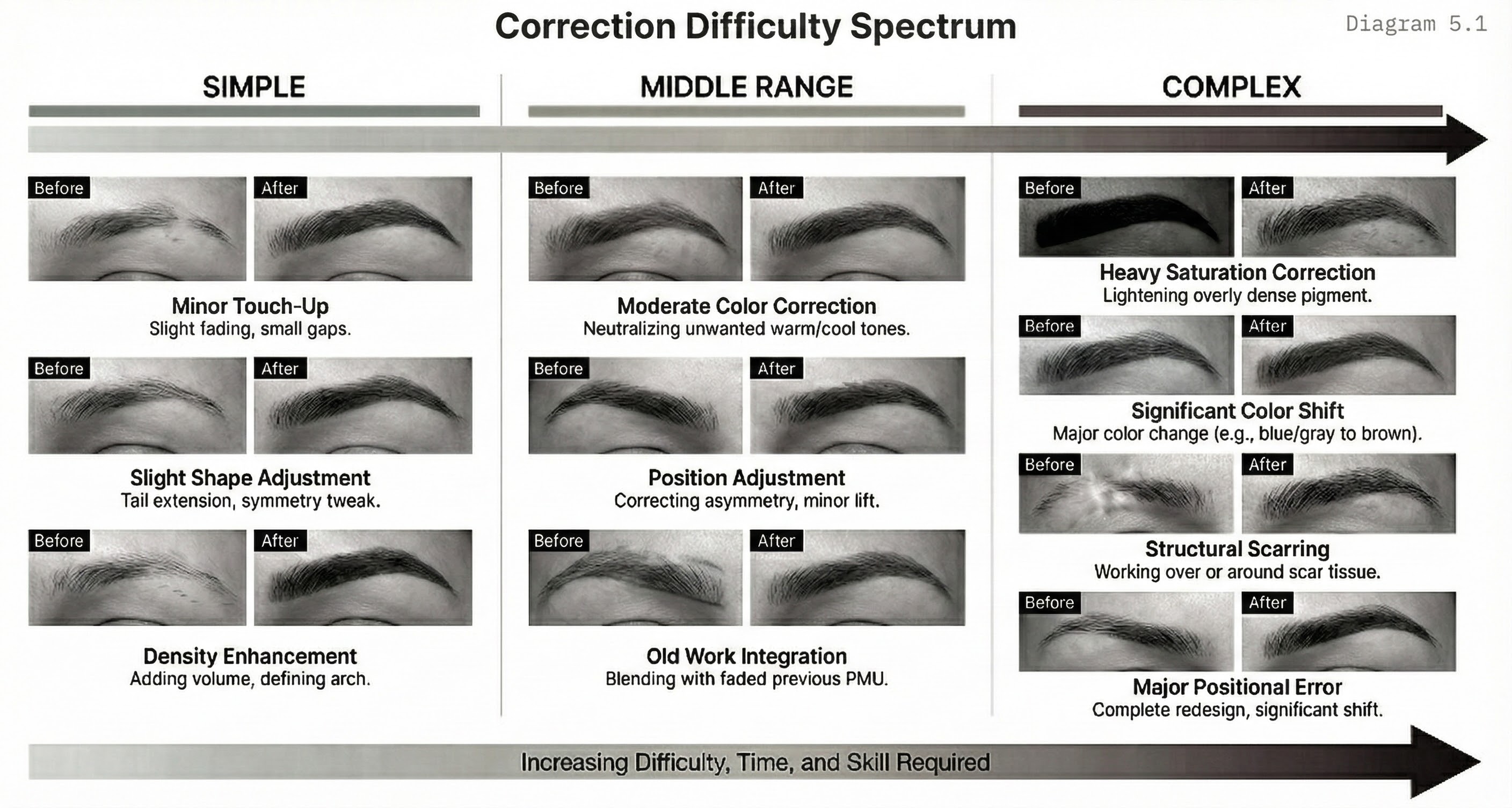
The Correction Difficulty Spectrum
Ranges from simple touch-up through major reconstruction. At the simple end are cases requiring minor adjustments to recent, well-executed work—filling small gaps, adjusting density, or minor shape refinement. At the complex end are cases involving heavily saturated old work, significant scarring, or previous work positioned far from anatomically appropriate locations.
Correction Difficulty Spectrum
Purpose: Visualise the range of correction complexity
A horizontal scale from simple corrections (left) to complex corrections (right). Case types are positioned along the spectrum with brief descriptors. Color coding indicates risk level.
Constraint Analysis
Identifies factors limiting correction options:
- Colour constraints: existing pigment that will mix with new applications; undertones that will emerge during correction attempts
- Structural constraints: scarring affecting pigment uptake; skin damage limiting technique options; tissue changes from previous trauma
- Position constraints: previous work placement that may be difficult or impossible to alter
Risk-Benefit Analysis
Weighs potential improvement against correction risks. Some correction attempts may produce worse outcomes than leaving existing work alone. The practitioner assesses:
- Likelihood of improvement
- Magnitude of possible improvement
- Likelihood of complications
- Potential severity of complications
Timeline Theory
Recognises that correction often requires multiple sessions with appropriate intervals. Single-session complete correction is rarely achievable in complex cases. Planning must encompass the full correction arc rather than focusing solely on immediate intervention.
Methodology
Correction assessment methodology begins with comprehensive evaluation of the existing situation. This evaluation characterises what is present, identifies what requires change, and assesses what changes are feasible.
Existing Work Assessment
Documents current characteristics in detail. For previous permanent work, note:
- Colour including undertones
- Saturation level and distribution
- Placement relative to anatomical landmarks
- Technique indicators (blade strokes versus machine work versus powder)
- Condition (crisp versus faded versus migrated)
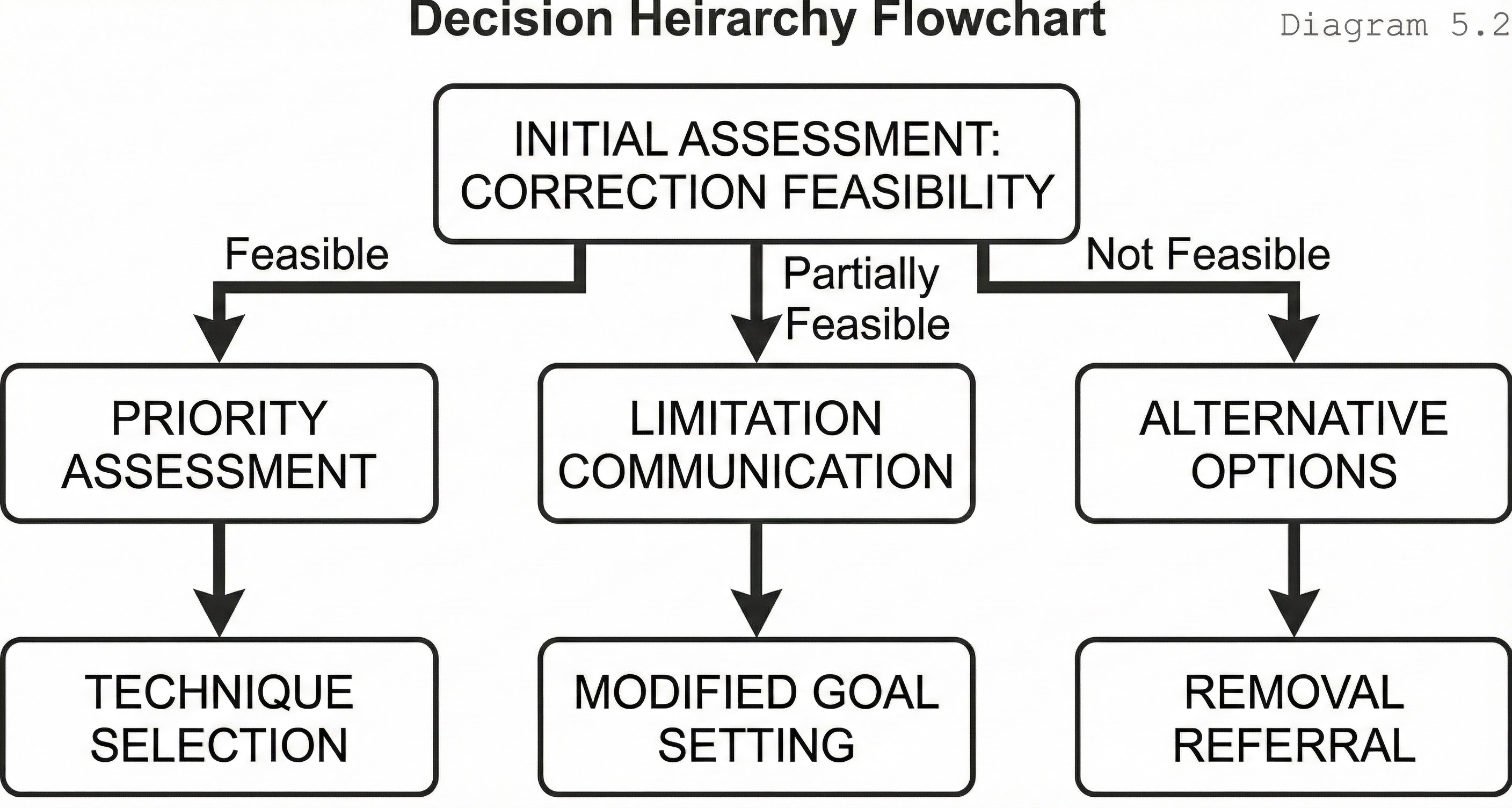
Decision Hierarchy Flowchart
Purpose: Guide correction case management decisions
A comprehensive decision tree for correction case management. Starting with initial assessment, branches address color issues, positional issues, saturation issues, and combination presentations.
Gap Analysis
Identifies discrepancies between current presentation and optimal outcome. The practitioner defines what optimal would look like for this client and systematically lists differences from current presentation. This gap analysis clarifies what correction must achieve.
Feasibility Assessment
Evaluates which gaps can be addressed through available interventions. Some gaps can be fully closed; others can be partially closed; some cannot be meaningfully addressed. Feasibility depends on the specific correction tools available, the characteristics of existing work, and the client's tissue response capacity.
Priority Ranking
Organises correction goals by importance and feasibility. When complete correction is not achievable, the practitioner must determine which improvements to prioritise. Colour correction may take priority over shape correction, or vice versa; the ranking depends on which elements most significantly affect overall appearance.
Strategy Development
Translates assessment findings into a correction plan specifying:
- Interventions in sequence
- Expected outcomes at each stage
- Decision points for evaluating progress
- Contingencies for unexpected developments
Techniques
Colour Correction Technique
Addresses pigment issues in previous work. For too-dark work, fading strategies may be employed before attempting correction. For colour-shifted work (warm tones becoming orange, cool tones becoming grey-blue), complementary corrector pigments may neutralise unwanted tones before new application.
Shape Modification Technique
Adjusts the apparent shape of previous work. Extension adds coverage beyond existing boundaries. Camouflage creates visual distraction from problematic elements. In some cases, complete removal through laser or saline becomes necessary before reshaping.
Density Adjustment Technique
Addresses saturation issues. Under-saturated areas can receive additional pigment. Over-saturated areas may require fading treatment before rebalancing. Achieving uniform density across corrected work presents particular challenges when blending new work with old.
Scar Integration Technique
Works with tissue damage from previous procedures or other sources. Scarred tissue often accepts pigment differently than normal skin—sometimes better, sometimes worse. Test patches assess tissue response before comprehensive treatment.
Professional Notes
Correction work requires enhanced documentation compared to initial work. The starting point must be thoroughly characterised; the correction plan must be explicit; outcomes at each stage must be recorded. This documentation supports continuity across multiple sessions and provides reference for managing client expectations.
Emotional complexity often accompanies correction cases. Clients seeking correction may feel distressed about existing work, may have difficult experiences with previous practitioners, or may harbour unrealistic hopes for correction outcomes. The practitioner addresses emotional dimensions alongside technical ones.
Knowing when not to correct represents advanced professional judgment. Some cases cannot be improved through available means; some cases risk becoming worse with intervention. The practitioner who recommends against treatment when appropriate demonstrates professional integrity.
Common Mistakes
Underestimating Correction Complexity: Leads to disappointment. The practitioner who approaches correction with the same expectations as initial work will encounter difficulties. Correction almost always requires more sessions, more time between sessions, and more modest outcome expectations.
Inadequate Assessment: Before planning correction produces flawed strategies. Rushing to develop a correction plan before thoroughly understanding existing conditions leads to approaches that encounter unexpected obstacles.
Over-Promising Outcomes: Damages client relationships. The practitioner who promises complete correction when partial correction is realistic creates client disappointment regardless of how well the work proceeds.
Single-Modality Thinking: Misses optimal solutions. Complex corrections often require combining approaches—perhaps laser fading followed by colour correction followed by shape modification. The practitioner who considers only one modality may miss superior combined strategies.
Expert Insights
Master practitioners develop correction intuition through accumulated experience. They recognise patterns indicating achievable correction versus patterns predicting poor outcomes. This pattern recognition operates alongside systematic assessment rather than replacing it.
Building referral relationships enhances correction capability. Complex cases may benefit from laser treatment, dermatological intervention, or other modalities beyond the brow practitioner's scope. The master maintains relationships with providers who can address what brow work alone cannot.
Long-term client relationships matter particularly in correction cases. Correction arcs spanning years rather than months are not uncommon. The practitioner who maintains relationship continuity provides superior correction care compared to one who approaches each session as isolated intervention.
Practical Application
Correction consultation differs from initial consultation in structure and emphasis. More time is allocated to existing work assessment; gap analysis receives explicit attention; feasibility discussion must be thorough and honest.
Treatment sessions in correction cases often accomplish less per session than initial work sessions. This reduced progress reflects the constraints of working with rather than on a fresh canvas. Session planning acknowledges this reality.
Follow-up protocols for correction cases include milestone assessments where progress against the correction plan is evaluated. These assessments may lead to plan revision as actual tissue response clarifies what is achievable.