Section 7: Applied Golden Ratio & Professional Geometry
Definition
The golden ratio (approximately 1:1.618) represents a mathematical proportion that appears throughout nature and has been employed in art and architecture across cultures and centuries. Applied to brow design, golden ratio principles provide geometric frameworks for positioning, proportion, and shape decisions.
Professional geometry extends beyond golden ratio to encompass all mathematical and proportional approaches to facial analysis and brow design.
At the mastery level, geometric principles serve as tools rather than rules.The practitioner understands ratio relationships, applies them diagnostically, and uses them as one input among many in design decisions. Geometric precision serves aesthetic goals rather than substituting for aesthetic judgment.
Theory
Golden Ratio Theory
Golden ratio theory posits that proportions approximating 1:1.618 produce visual harmony. In facial application, this ratio appears between facial zones, feature relationships, and within individual feature proportions. Golden ratio proponents argue that faces approaching this proportion are perceived as more attractive and that design decisions should aim toward golden ratio relationships.
Critique of Golden Ratio Absolutism
Critique of golden ratio absolutism notes that natural faces rarely exhibit exact golden ratio proportions, that perception of beauty extends well beyond mathematical proportion, and that cultural and individual variation in aesthetic preference cannot be reduced to geometric formula. The sophisticated practitioner recognises golden ratio as one aesthetic influence among many rather than as universal determinant of beauty.
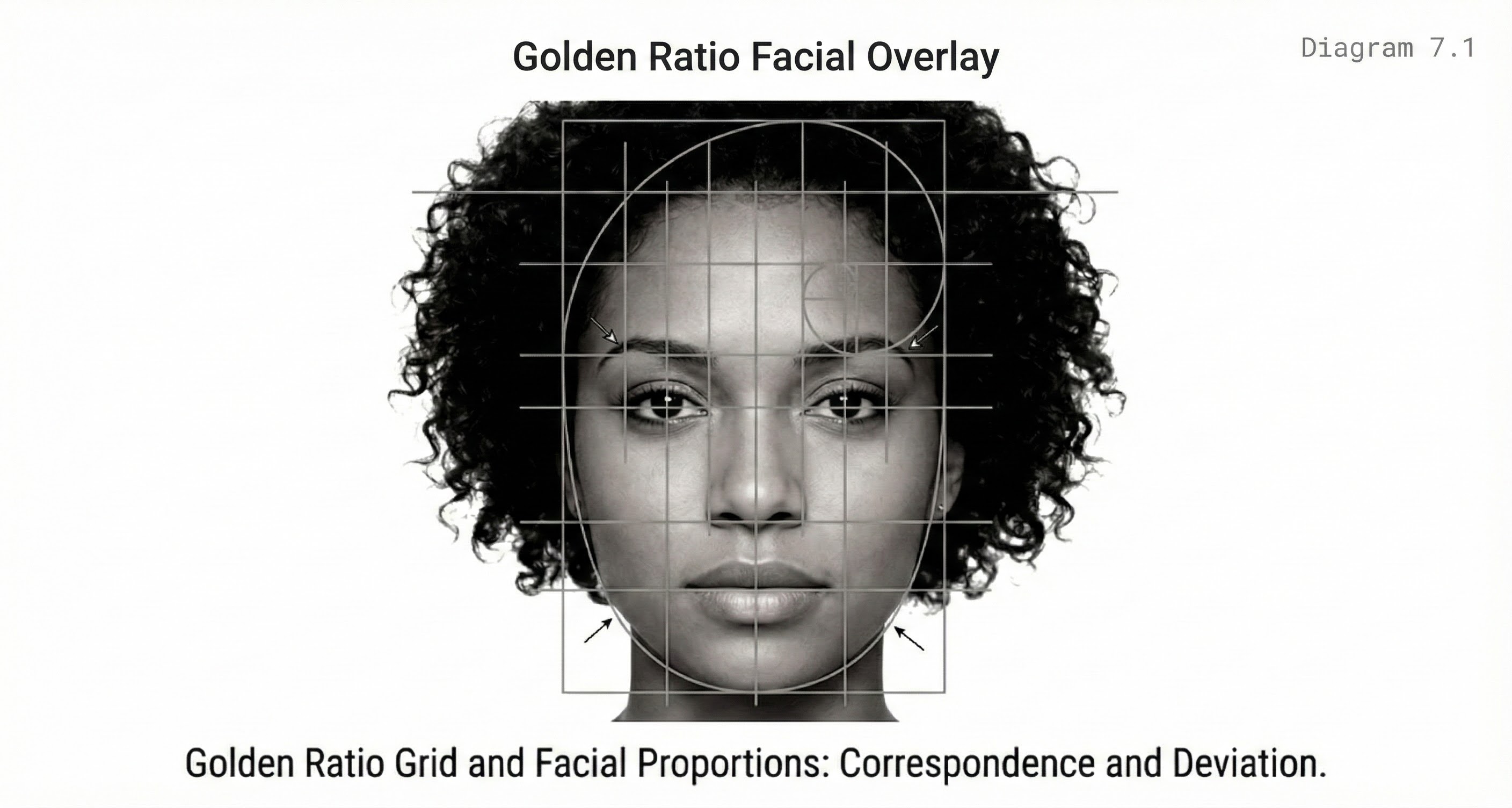
Golden Ratio Facial Overlay
Purpose: Show phi relationships in facial proportion
A face with golden ratio grid overlay. Key phi relationships are highlighted: hairline to brow, brow to nose base, nose base to chin. Brow positioning within the grid is indicated.
Brow-Specific Ratio Applications
Brow-specific ratio applications include:
- Relationships between brow length and facial width
- Relationships between arch position and brow extent
- Relationships between head-to-arch and arch-to-tail distances
These ratios provide starting points for design that can be adjusted based on individual anatomy and preference.
Non-Ratio Geometry
Non-ratio geometry provides additional design tools. Brow positioning relative to orbital landmarks uses geometric relationships without ratio calculation. Symmetry assessment employs geometric comparison between sides. Angle measurement characterises arch sharpness, tail descent, and other shape features.
Methodology
Geometric analysis methodology applies mathematical frameworks to facial and brow assessment. The process identifies relevant measurements, calculates ratio relationships, and interprets findings in terms of design implications.
Facial Proportion Analysis
Facial proportion analysis examines relationships between facial zones and features. Facial thirds are measured and compared. Eye spacing relative to facial width is calculated. These broader proportions provide context for brow-specific analysis.
Brow Ratio Analysis
Examines internal brow proportions and brow relationships to facial features:
- Head-to-arch versus arch-to-tail distances are measured and compared
- Brow length relative to eye width is calculated
- Arch height relative to brow thickness is assessed
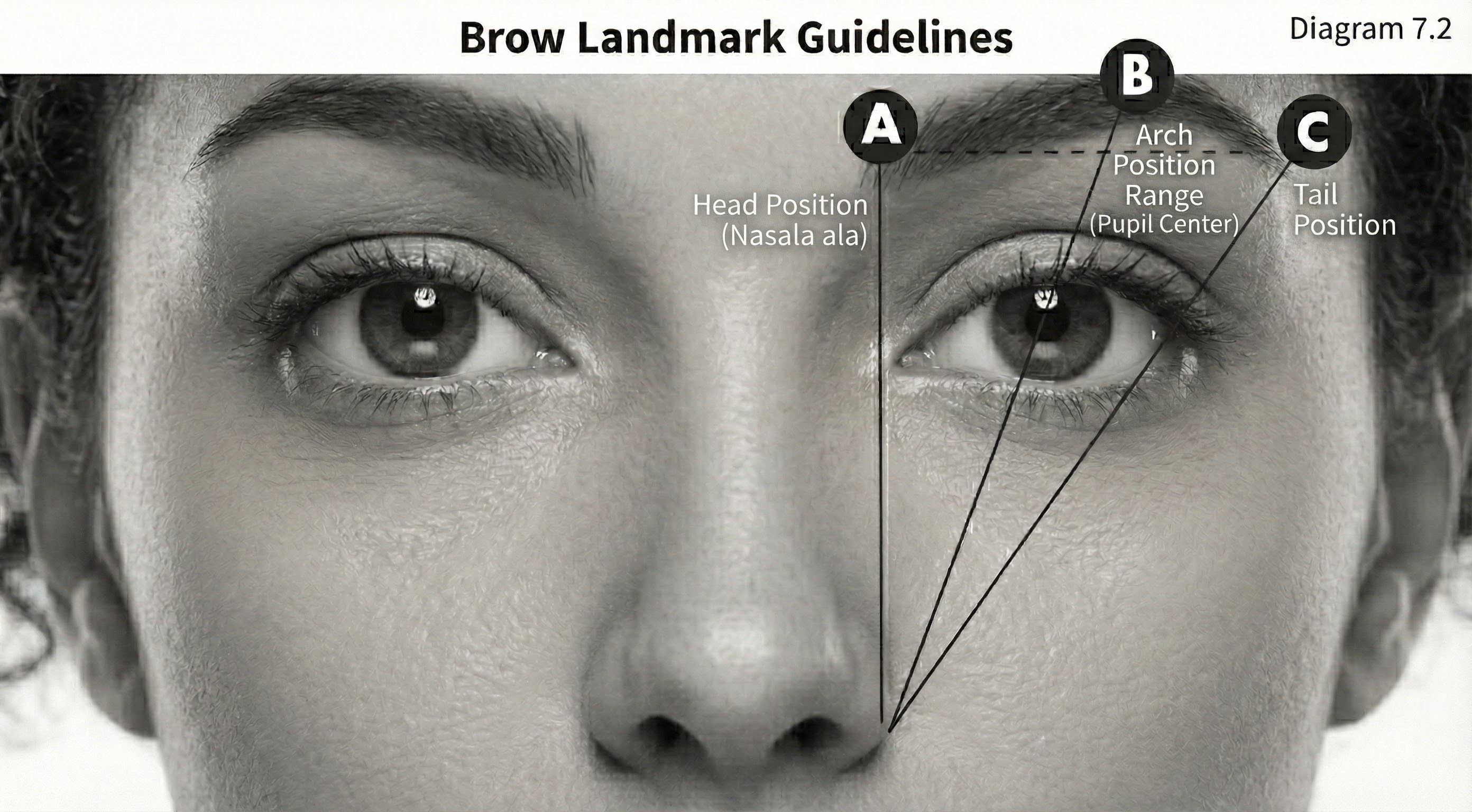
Brow Landmark Guidelines
Purpose: Illustrate standard landmark projection methods
A face showing standard brow landmark projection lines: vertical from nostril edge to brow start, diagonal from nostril through iris to arch, diagonal from nostril through outer eye to brow end.
Landmark Positioning Analysis
Identifies optimal brow placement points using geometric relationships:
- The head typically aligns with a vertical line from the nasal ala
- The arch typically falls somewhere between pupil centre and lateral limbus
- The tail typically terminates along a line from nasal ala through lateral canthus
These landmarks provide geometric reference points for positioning.
Deviation Analysis
Deviation analysis identifies where the client's existing proportions differ from geometric ideals. This analysis informs design decisions about whether and how to adjust toward ideals while respecting individual characteristics.
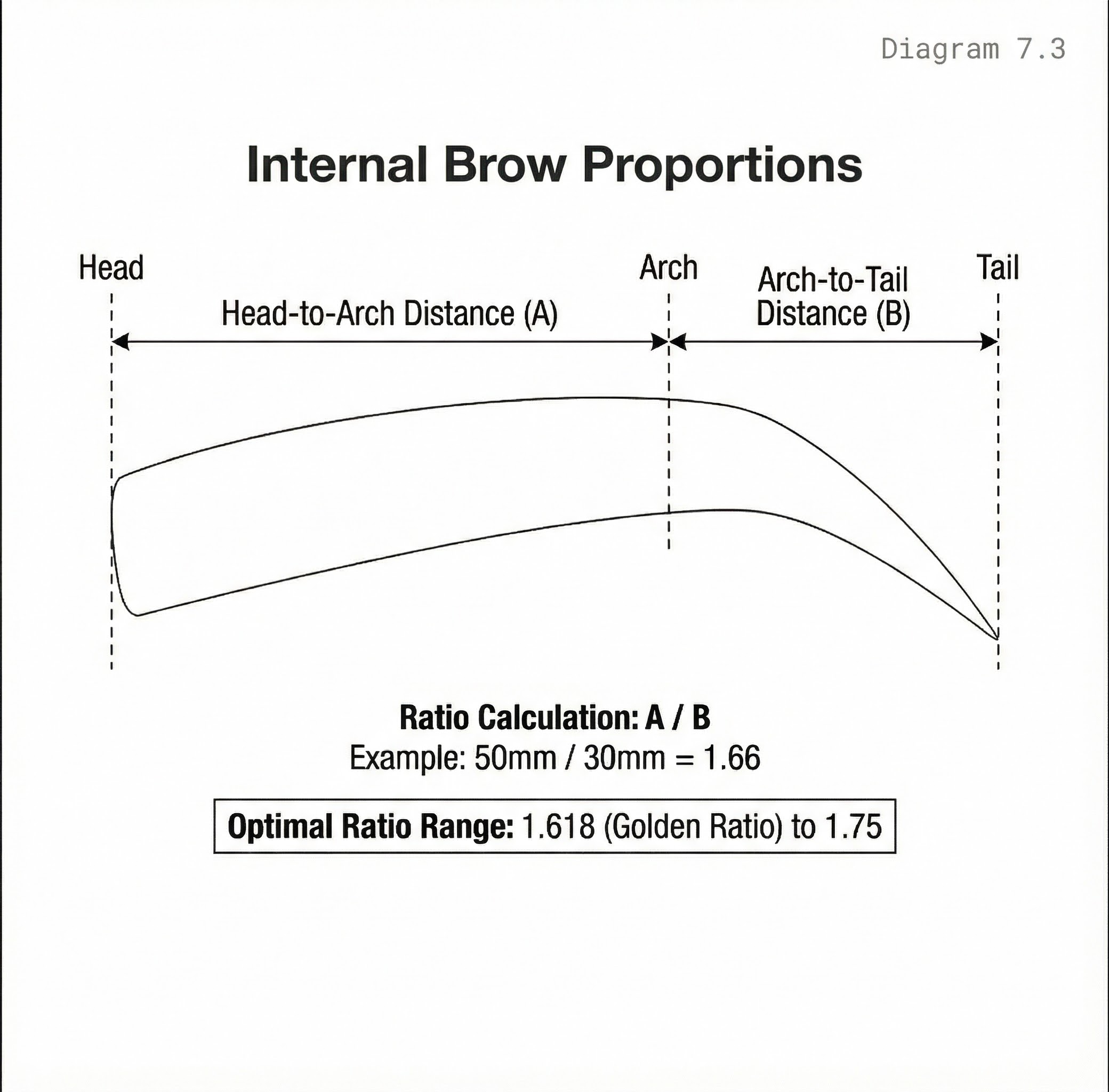
Internal Brow Proportions
Purpose: Define proportional relationships within the brow
A brow with measurement indicators showing internal proportions: head-to-arch ratio, arch-to-tail ratio, thickness ratios at different zones, and overall length reference.
Techniques
Ratio Measurement Technique
Ratio measurement technique uses calibrated tools to assess proportional relationships. Calipers or marked rulers measure relevant distances. Calculated ratios are compared to golden ratio and other reference values. Documentation of ratio findings supports design decision-making.
Landmark Projection Technique
Landmark projection technique uses straight edges or string to extend landmark-based guidelines. The nasal ala to medial canthus line, when extended, indicates head positioning. The nasal ala through lateral canthus line indicates tail termination. These projections create visible reference during design and execution.
Digital Ratio Analysis Technique
Digital ratio analysis technique uses software to overlay ratio frameworks on client photographs. Phi grids and other geometric overlays facilitate visual ratio assessment. Digital measurement tools provide precise quantification of relationships.
Comparative Proportion Technique
Comparative proportion technique presents golden ratio reference alongside individual measurements. Side-by-side comparison helps clients understand how their proportions relate to geometric ideals and what design adjustments might achieve.
Professional Notes
Geometric analysis provides objective reference points in a field that can be dominated by subjective judgment. The practitioner who can explain design decisions in geometric terms demonstrates professional rigor and provides clients with comprehensible rationale.
Over-reliance on geometry produces mechanical designs that lack organic quality.The face is not a mathematical diagram; designs that prioritise geometric precision over natural appearance may appear artificial. Geometry should inform, not dictate.
Client communication regarding geometry must be accessible. Most clients lack mathematical background for detailed ratio discussion. The practitioner translates geometric analysis into terms clients can understand and relate to their appearance goals.
Common Mistakes
Golden Ratio Dogmatism: Treats geometric proportion as absolute determinant of beauty. This ignores the complexity of aesthetic perception and the validity of individual variation. The practitioner should use ratio as guide, not mandate.
Measurement Imprecision: Undermines geometric analysis value. If landmarks are inconsistently identified or measurements are carelessly taken, resulting ratio calculations are meaningless. Geometric analysis requires technical precision to provide useful information.
Ignoring Geometry Entirely: Leaves the practitioner without objective reference points. Pure intuition may produce excellent results but lacks the communicable rationale that supports client understanding and professional development.
Geometric Analysis Paralysis: Occurs when the practitioner becomes so focused on measurements and ratios that design decision-making stalls. Analysis should facilitate decisions, not prevent them.
Expert Insights
Experienced practitioners internalise geometric principles to the point of automatic application. Through extensive practice, ratio awareness becomes intuitive; the practitioner sees proportional relationships without conscious calculation.
The most elegant designs often involve judicious departure from geometric ideals. Strict adherence produces predictable results; skilled deviation produces distinctive beauty. The master knows when to follow geometry and when to depart from it.
Geometric frameworks evolve with practice and research. The practitioner remains open to new approaches while maintaining competency in established methods. Continuing education in geometric analysis supports ongoing refinement of analytical capability.
Practical Application
Geometric analysis integrates into consultation protocol following structural and dynamic assessment. The practitioner conducts relevant measurements, calculates ratios, and incorporates findings into design discussion.
Design proposals reference geometric findings where relevant. Explaining how proposed design relates to facial proportions and landmark positions provides rationale clients can understand and evaluate.
Outcome evaluation includes geometric comparison of achieved results to design specifications and to geometric ideals. This evaluation informs future practice and demonstrates design-to-execution accuracy.