Section 8: Pigment Science, Undertones & Colour Control
Definition
Pigment science encompasses the chemical composition, optical properties, and biological interactions of colorants used in permanent and semi-permanent brow procedures. Undertone theory addresses the underlying colour biases in both pigments and skin that influence how implanted colour will appear and evolve.
Colour control refers to the techniques and decision frameworks for achieving and maintaining desired colour outcomes.
At the mastery level, colour management extends beyond basic pigment selectionto encompass prediction of how colours will interact with specific skin characteristics, how they will evolve over time, and how they can be manipulated to achieve precise outcomes.
Theory
Pigment Chemistry Theory
Pigment chemistry theory distinguishes between organic and inorganic colorants:
- Organic pigments — derived from carbon-based compounds, offer bright, pure colours but may fade less predictably and are more susceptible to laser breakdown
- Inorganic pigments — typically metal oxides, offer stability and predictable fading but may shift in colour over time, particularly toward warmer tones as the cooler components fade preferentially
Colour Theory Fundamentals
Colour theory fundamentals apply to pigment work. Primary colours (in pigment mixing: cyan, magenta, yellow) combine to create secondary and tertiary colours. Complementary colours neutralise each other when mixed. Understanding colour relationships enables prediction of how pigments will interact and how colour corrections can be achieved.
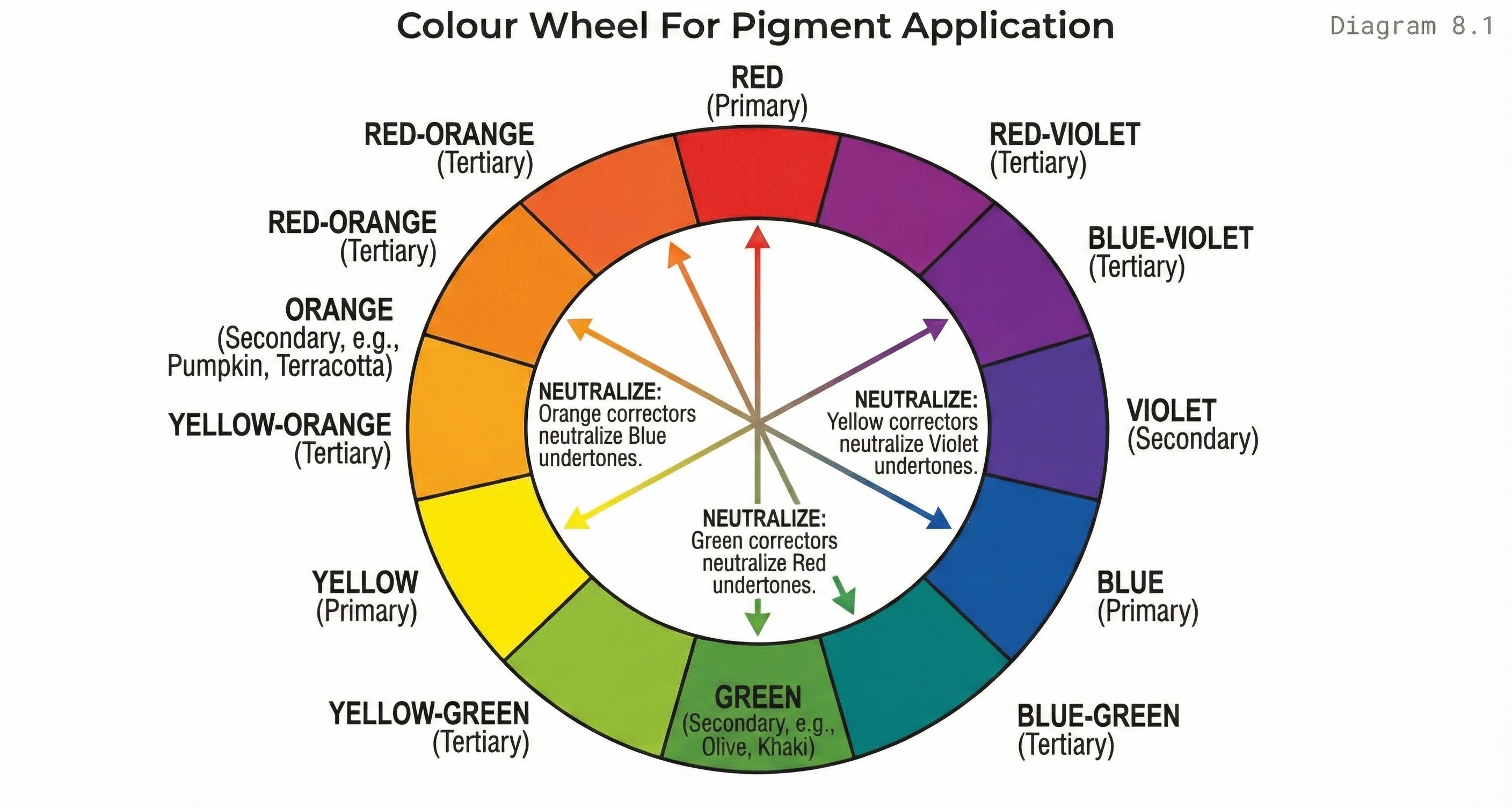
Colour Wheel for Pigment Application
Purpose: Guide colour selection and correction
A standard colour wheel with annotations specific to brow pigment application. Complementary pairs are highlighted with correction arrows. Cool and warm zones are indicated.
Undertone Theory
Undertone theory recognises that both pigments and skin carry underlying colour biases. Pigment undertones—warm (yellow, orange, red) or cool (blue, green, violet)—influence how the pigment reads once implanted. Skin undertones similarly affect how implanted colour appears. The interaction between pigment and skin undertones determines final visible colour.
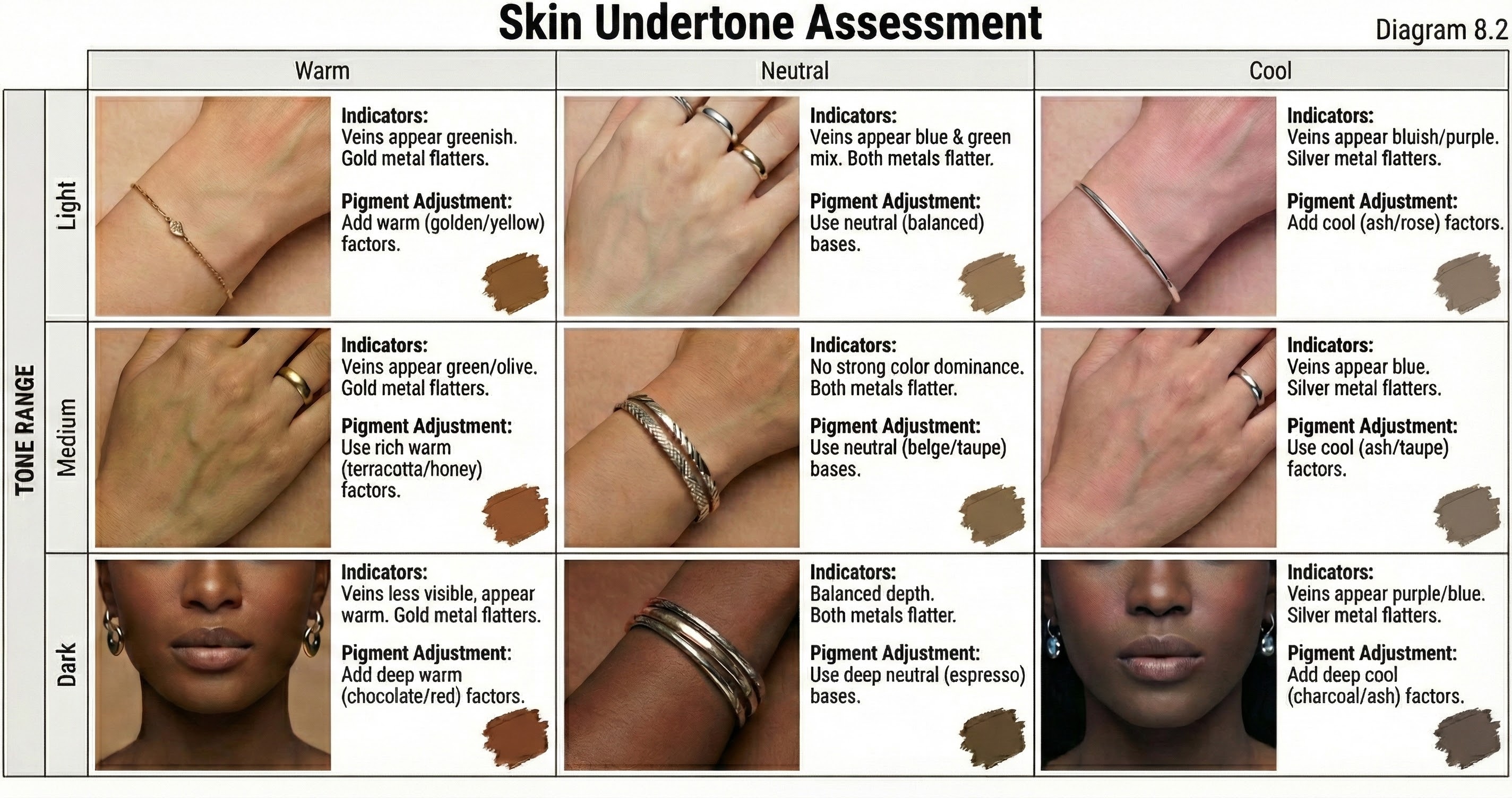
Skin Undertone Assessment Chart
Purpose: Systematise undertone classification
A grid with warm-neutral-cool on one axis and light-medium-dark on the other. Each cell contains a skin tone sample and recommended pigment undertone considerations.
Depth Theory
Depth theory addresses how deeply pigment is implanted and how this affects colour appearance and longevity. Superficial implantation produces brighter initial colour but typically fades faster. Deeper implantation may appear more muted initially but can offer better retention. Depth also affects colour shift patterns; deeper pigment may be more subject to warm-shift as certain components metabolise.
Evolution Theory
Evolution theory addresses how implanted colour changes over time. Most brow pigments will fade and may shift in hue as different colour components degrade at different rates. Understanding typical evolution patterns supports both initial colour selection and client expectation management.
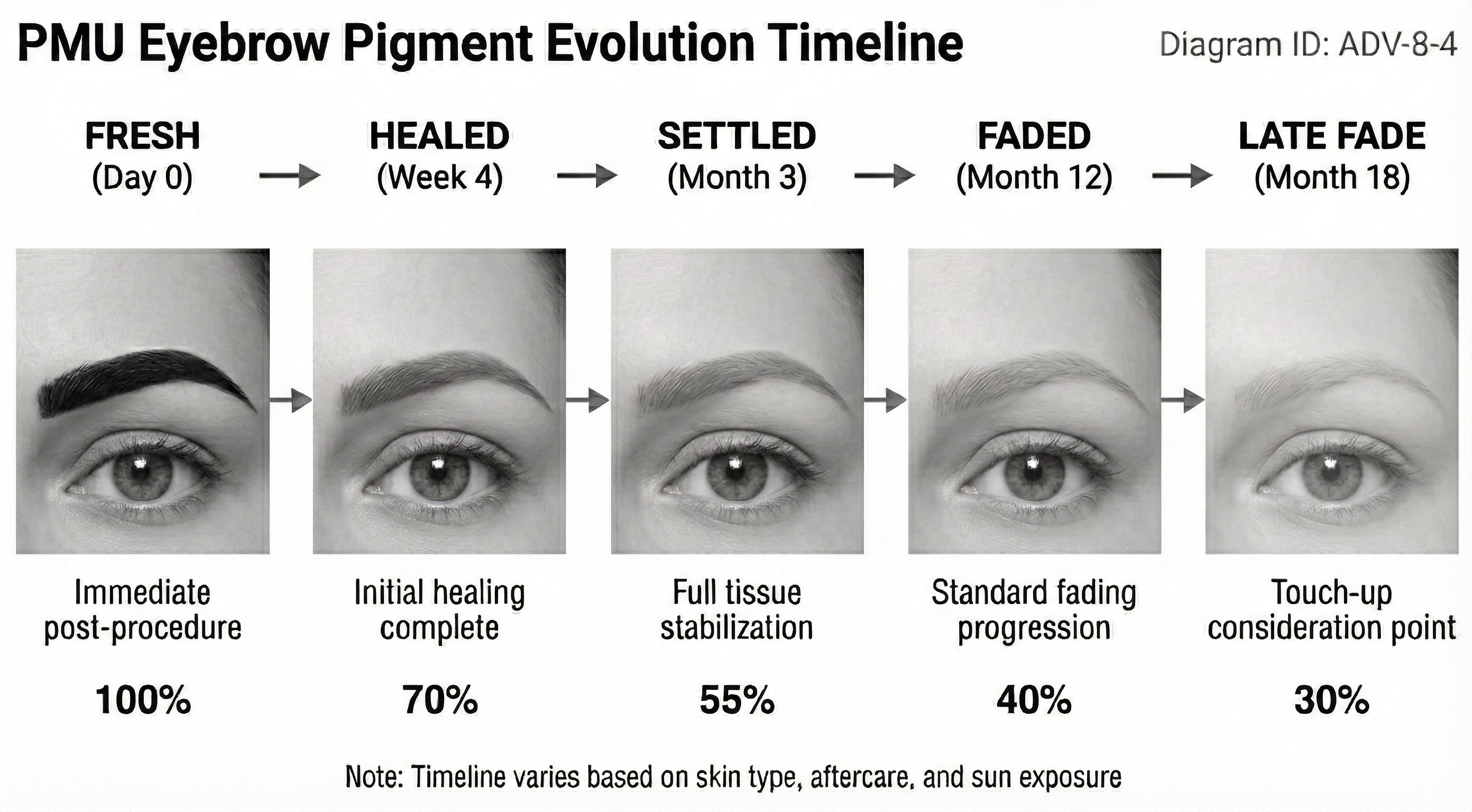
Pigment Evolution Timeline
Purpose: Show how pigment changes over time
A timeline showing pigment appearance at fresh application, healed (4 weeks), settled (3 months), faded (12 months), and late fade (18 months). Colour swatches illustrate evolution.
Methodology
Skin Analysis Methodology
Skin analysis methodology assesses characteristics that will influence pigment interaction and outcome:
- Skin tone — the overall lightness or darkness
- Undertone — the underlying colour bias
- Quality — thickness, texture, oiliness, sensitivity
All affect how pigment will appear and behave.
Fitzpatrick Typing
Fitzpatrick typing provides standardised skin classification but requires supplementation with undertone assessment. The Fitzpatrick scale addresses sun response and general tone but does not directly indicate undertone. Separate undertone assessment—examining vein colour, jewelry flattery, and comparison to standard swatches—completes the skin analysis.
Pigment Selection Methodology
Pigment selection methodology matches pigment characteristics to skin analysis findings and desired outcome. The practitioner considers skin undertone in selecting pigment undertone—cool skin may require warming pigment to avoid grey appearance; warm skin may require cooling pigment to avoid orange appearance. Tone matching balances pigment darkness against skin tone and desired intensity.
Mix Formulation Methodology
Mix formulation methodology addresses custom pigment blending for precise colour achievement. The practitioner uses colour theory to create mixes that achieve specific targets, adding warm or cool modifiers as indicated, adjusting depth through dilution or concentration.
Test Patch Methodology
Test patch methodology validates pigment selection before full procedure. Small test applications, assessed after healing, confirm whether selected pigment produces desired outcome in the specific client's skin.
Techniques
Swatch Testing Technique
Swatch testing technique compares pigment swatches to skin for visual matching. Pigment is applied to disposable cards or directly to skin surface (without penetration) and assessed under consistent lighting. Multiple options are compared to identify optimal match.
Undertone Neutralisation Technique
Undertone neutralisation technique applies complementary colour principles to prevent unwanted tone appearance. If skin tends to shift warm, cooler pigment compensates. If previous work has shifted orange, violet-based corrector neutralises before new application.
Layering Technique
Layering technique builds colour through multiple passes, allowing assessment between layers. Initial passes establish foundation; subsequent passes adjust toward target. This incremental approach permits real-time colour assessment and adjustment.
Saturation Control Technique
Saturation control technique manages colour intensity through pass number, needle saturation, and skin stretching. More saturated outcomes require more pigment deposition; softer outcomes require restrained application. The practitioner develops calibrated control over saturation achievement.
Professional Notes
Pigment knowledge requires ongoing education as formulations evolve. Pigment manufacturers regularly update their offerings; the practitioner maintains current knowledge of available options and their characteristics.
Colour prediction improves with experience. Each client interaction provides data about how pigment behaves in specific skin types. The practitioner who systematically documents pigment selections, skin characteristics, and healed outcomes builds predictive accuracy.
Colour literacy facilitates client communication. The practitioner develops vocabulary and visual aids for discussing colour concepts with clients who may lack colour training.
Common Mistakes
Ignoring Undertones: Produces unpredictable colour outcomes. The practitioner who selects pigment based on surface colour match alone may find healed results significantly different than expected. Comprehensive undertone assessment prevents this error.
Oversaturation: Exceeds desired intensity and may be difficult to correct. The practitioner who applies too aggressively creates outcomes darker than intended. Conservative initial application with buildup as needed prevents oversaturation.
Under-Communication Regarding Colour Evolution: Creates expectation mismatch. Clients may expect permanent colour stability when fading and shift are normal. Thorough explanation of typical evolution supports appropriate expectations.
Single-Product Reliance: Limits colour achievement options. The practitioner who works only with one pigment line may lack options for specific client needs. Familiarity with multiple pigment systems expands capability.
Expert Insights
Master colourists develop intuitive undertone reading—the ability to assess skin undertone immediately upon observation. This intuition develops through extensive practice and deliberate attention to undertone indicators.
Complex colour challenges often have simple solutions once underlying factors are understood. The case that seems difficult may become straightforward when pigment and skin interactions are properly analysed.
Colour mastery requires both theoretical understanding and practical experience. Theory provides framework; practice develops the nuanced judgments that theory alone cannot teach.
Practical Application
Colour consultation occurs after structural and shape decisions are established. With design determined, the practitioner conducts skin analysis, discusses colour goals, and develops pigment selection recommendations.
Pigment selection is documented in the client record along with rationale. This documentation supports future appointments and helps with troubleshooting if outcomes deviate from expectations.
Follow-up appointments assess colour outcome and evolution. The practitioner documents healed colour and compares to immediate post-procedure appearance, tracking how the specific pigment has behaved in the specific client's skin.