Section 4: Asymmetry Diagnosis & Correction Strategy
Definition
Asymmetry diagnosis is the systematic identification and characterisation of differences between the left and right sides of the face and brows. Correction strategy encompasses the approaches available for addressing identified asymmetries through brow design.
At the mastery level, asymmetry management becomes a core competency rather than an occasional challenge—most faces present some degree of asymmetry, and skilled management is the norm rather than the exception.
Bilateral symmetry represents an idealised concept that natural faces rarely achieve. Developmental variation, habitual expression patterns, unilateral aging effects, previous interventions, and countless other factors produce the asymmetries that characterise real faces. The master practitioner recognises, quantifies, and strategically addresses asymmetry rather than either ignoring it or attempting to eliminate it entirely.
Theory
Asymmetry theory begins with categorisation of asymmetry types.
Structural Asymmetry
Arises from skeletal differences between sides—different supraorbital ridge prominence, unequal orbital size or position, asymmetric frontal bone development. Structural asymmetries are fixed and cannot be altered through brow work; they must be accommodated in design.
Soft Tissue Asymmetry
Involves differences in muscle bulk, fat distribution, or skin quality between sides. Unequal frontalis development may produce different elevation potential. Asymmetric fat pad distribution may create apparent differences in brow position. These asymmetries may be modifiable through intervention or may require design accommodation.
Positional Asymmetry
Refers to differences in where corresponding structures sit on each side. One brow may rest higher than the other, one eye may appear larger, one orbital rim may sit lower. Positional asymmetries have varied causes—structural, muscular, or habitual—and appropriate response depends on underlying cause.
Asymmetry Types
Purpose: Distinguish four categories of facial asymmetry
Four faces showing different asymmetry categories: structural (bone-based), soft tissue (fat/skin-based), positional (brow placement), and dynamic (expression-related). Each type is labeled with characteristic features.
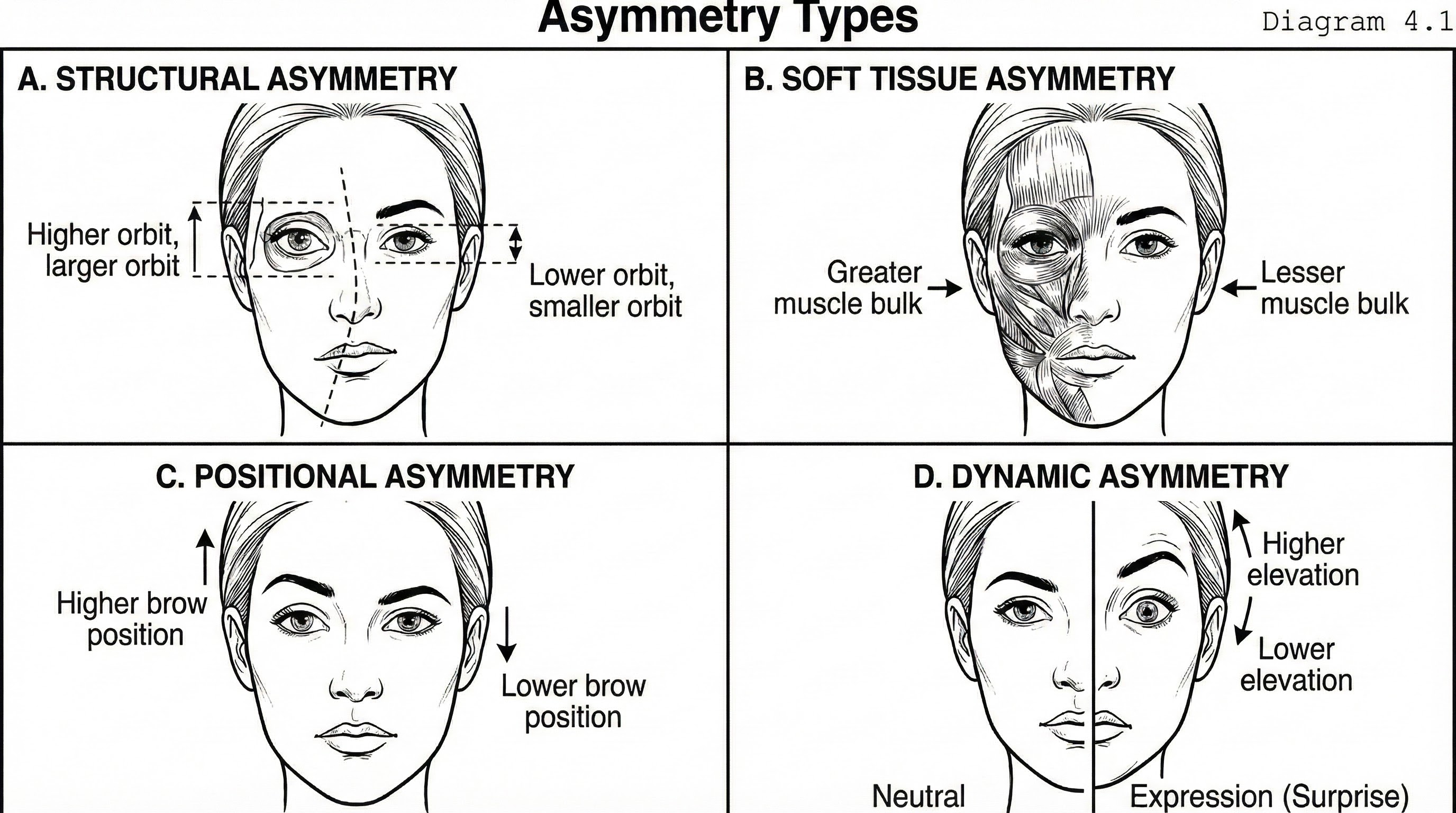
Dynamic Asymmetry
Involves differences in movement between sides. One side may elevate more during expression, or depress more during frowning. Dynamic asymmetries may be invisible at rest but pronounced during animation. Design must account for dynamic as well as static asymmetry.
Asymmetry Perception Theory
Recognises that objective asymmetry and perceived asymmetry may differ. Minor objective asymmetries may go unnoticed while certain asymmetry patterns command attention disproportionate to their magnitude. Understanding which asymmetries matter perceptually guides prioritisation of correction efforts.
Methodology
Asymmetry diagnosis methodology proceeds through systematic bilateral comparison across multiple parameters. The protocol examines structural landmarks, soft tissue characteristics, static positions, and dynamic behaviour, documenting differences in each domain.
Structural Landmark Comparison
Identifies skeletal asymmetries through bilateral measurement:
- Measure from midline to corresponding landmarks on each side, comparing distances
- Compare supraorbital ridge prominence through bilateral palpation
- Assess orbital rim positions for differences in height, depth, and contour
Brow Position Comparison
Quantifies static asymmetries in brow placement. Key measurements include:
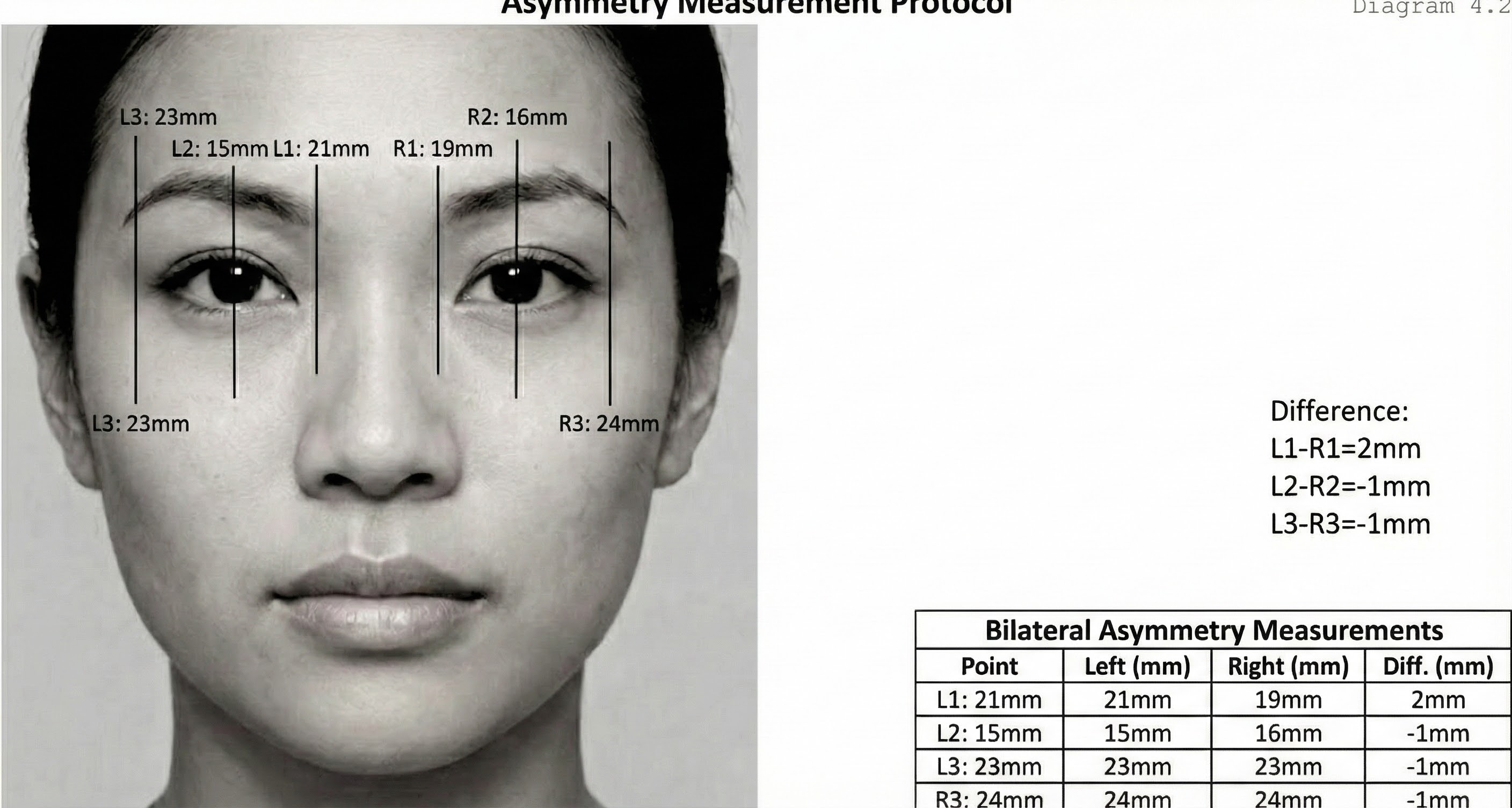
- Brow height at medial, apex, and lateral points
- Brow arch position relative to pupil
- Brow length from head to tail
- Brow thickness at multiple points
These measurements are compared between sides and differences documented.
Asymmetry Measurement Protocol
Purpose: Standardise bilateral comparison measurements
A face with bilateral measurement lines showing paired measurements at multiple levels. Horizontal reference lines establish baseline. Vertical measurements from baseline to brow landmarks are indicated.
Facial Feature Comparison
Places brow asymmetry in context of broader facial asymmetry. Eye size difference, canthal position difference, and orbital shape difference all influence how brow asymmetry appears. Brow asymmetry may compensate for or exacerbate other facial asymmetries.
Dynamic Comparison
Assesses movement differences through bilateral observation during expression. The client performs elevating and depressing movements while the practitioner observes for differences in range, speed, or pattern. Video documentation supports detailed dynamic comparison through repeated review.
Cause Analysis
Attempts to identify factors underlying observed asymmetries:
- Structural causes are identified through bone mapping
- Muscular causes are identified through palpation and strength testing
- Habitual causes may be revealed through client interview regarding sleeping position, frequent expressions, or occupational factors
Techniques
Measurement Technique
For asymmetry quantification, uses consistent landmarks and tools. The practitioner identifies corresponding points on each side—medial canthus, lateral canthus, pupil centre at primary gaze—and measures brow position relative to these landmarks bilaterally.
- Digital calipers provide precision
- Marked flexible rulers offer convenience
- All measurements are documented in comparable units
Photographic Analysis Technique
Supports objective asymmetry assessment. Standardised photographs with grid overlay facilitate bilateral comparison. Software tools can measure pixel distances and angles. Mirror-image overlay—flipping one side and superimposing on the other—dramatically reveals asymmetries that casual observation misses.
Client Education Technique
Involves demonstrating asymmetries the client may not have noticed. Using a mirror, the practitioner guides the client's attention to asymmetric features. This educates the client about their specific asymmetry profile and supports realistic expectation setting regarding what correction can achieve.
Asymmetry Mapping Technique
Creates visual documentation of all identified asymmetries. Using a photograph or diagram, the practitioner annotates differences between sides, creating a comprehensive asymmetry map. This map guides correction strategy development and supports communication with the client.
Professional Notes
Asymmetry diagnosis sensitivity develops with experience. Early practitioners may notice only obvious asymmetries; master practitioners detect subtle differences that nevertheless affect aesthetic outcome. This sensitivity develops through deliberate practice and systematic comparison across many faces.
Client awareness of asymmetry varies widely. Some clients are acutely aware of asymmetries and seek correction as primary goal. Others have not noticed asymmetries and may be disturbed by having them identified. The practitioner assesses client awareness and calibrates communication accordingly.
Correction limitations must be understood and communicated. Brow design cannot correct skeletal asymmetry—it can only work within or camouflage structural constraints. Setting appropriate expectations regarding what correction can achieve prevents disappointment and supports informed consent.
Common Mistakes
Overcorrection Attempts: Frequently produce worse outcomes than asymmetry acceptance. The practitioner who tries to achieve perfect symmetry often creates obviously artificial results or shifts asymmetry to a new form. Strategic partial correction typically produces superior aesthetic outcomes.
Ignoring Asymmetry Causes: Leads to inappropriate correction approaches. Attempting to correct structural asymmetry through brow design alone will fail; structural limitations must be acknowledged. Attempting to correct muscle-based asymmetry without addressing muscle function may produce temporary results that dynamic behaviour undermines.
Failing to Educate Clients: Creates expectation mismatch. Clients may expect symmetric results that are not achievable given their anatomy. Comprehensive asymmetry education during consultation prevents disappointment at outcome review.
Asymmetry Hyperfocus: Causes practitioners to see asymmetry everywhere, including within normal variation ranges. Not all differences require correction; bilateral perfect symmetry would itself appear artificial. The practitioner develops judgment regarding which asymmetries warrant intervention.
Expert Insights
Master practitioners recognise that strategic asymmetry may enhance rather than diminish aesthetic outcome. Identical brows on an asymmetric face may appear more asymmetric than brows designed to accommodate facial asymmetry. The goal is harmonious appearance rather than geometric identity.
Asymmetry correction prioritisation reflects perceptual impact rather than objective magnitude. Some asymmetries read as characteristic; others read as flaws. The experienced practitioner distinguishes between asymmetries that contribute to individual character and asymmetries that detract from appearance.
Long-term thinking informs asymmetry management. Asymmetries may evolve with aging, and correction approaches should anticipate this evolution. The correction strategy that works well at present may become problematic as the face continues to change.
Practical Application
Asymmetry assessment is integrated into standard consultation protocol. Following structural and dynamic assessment, the practitioner conducts bilateral comparison and documents all identified asymmetries. This documentation informs design development and supports client communication.
Design proposals explicitly address identified asymmetries. The practitioner explains which asymmetries will be corrected, which will be accommodated, and which will remain visible. This transparency supports informed decision-making and realistic expectation formation.
Follow-up assessment evaluates correction effectiveness. The practitioner compares post-procedure bilateral measurements to pre-procedure documentation, assessing what correction was achieved. Client satisfaction with asymmetry management is specifically queried.