Section App. 15: Case-Based Execution Strategies for Master Artists
Definition
Case-based execution strategy is the synthesis of everything in this volume into coherent action on a specific client. Every preceding chapter has addressed a component: structural reading, dynamic assessment, asymmetry management, colour theory, blade mechanics, healing prediction, client psychology. This chapter addresses how those components integrate when a real person sits in your chair with a real face, real expectations, and real skin.
No two clients present the same combination of variables.A thin-skinned client with high arches, oily T-zone, previous bad PMU, unrealistic expectations from Instagram, and a time constraint is not a textbook case. She is a specific constellation of structural, technical, and psychological factors that requires a specific strategy. The ability to formulate that strategy quickly and execute it effectively is what this chapter develops.
Theory
Integration Under Pressure
In isolation, each assessment domain is manageable. Structural reading is a learnable skill. Colour selection follows principles. Client psychology responds to frameworks. The challenge is performing all of them simultaneously, in real time, while the client is watching, while the clock is running, and while making decisions that are difficult to reverse.
This integration becomes automatic through experience, but it can be accelerated through structured case analysis. By working through cases systematically (even hypothetical ones), the practitioner builds mental models that compress multi-step analysis into rapid pattern recognition. The experienced practitioner does not consciously run through every assessment domain for every client. They recognise patterns that trigger specific strategies, then verify their pattern recognition against systematic assessment.
Strategy Formation
A strategy is not a plan. A plan says what you will do. A strategy says what you will do, why, what you will do if that does not work, and what the acceptable and unacceptable outcomes are. For each client, the practitioner should be able to articulate: the primary design approach and its rationale, the technique parameters and why they were selected for this skin, the client communication approach and why it suits this person, the contingencies (if the skin responds differently than expected, if the client becomes anxious, if time runs short), and the definition of a successful outcome for this specific case.
Case Synthesis Model
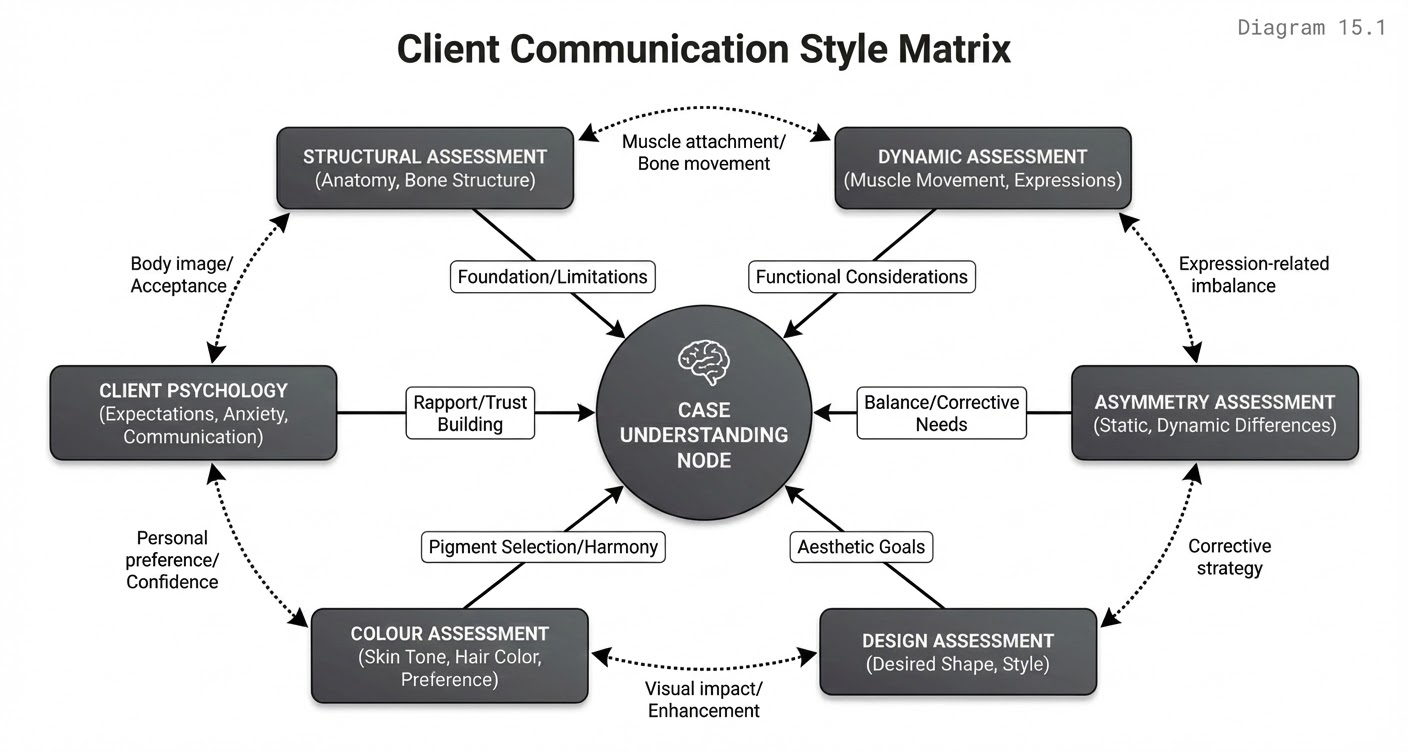
Purpose: Show how assessment elements integrate
A central node representing case synthesis with connecting lines to assessment domains: structural, muscular, asymmetry, correction, design, pigment, hair flow, and client factors.
Adaptive Execution
No strategy survives first contact with reality unchanged. The skin responds differently than assessed. The client's anxiety is higher than anticipated. The healing from previous work is more extensive than it appeared. The practitioner who is rigidly committed to the pre-procedure plan will force a strategy onto a situation it no longer fits. The adaptive practitioner modifies the strategy while maintaining the underlying intent.
Adaptive execution requires knowing which variables are negotiable and which are not. Stroke placement can adapt. Blade selection can change mid-procedure if the tissue response demands it. Depth can be recalibrated. But the overall design intent, the architectural logic agreed with the client, should remain stable unless a fundamental reassessment occurs. Changing the design mid-procedure without client agreement is a boundary violation regardless of how well-intentioned the change might be.
Methodology
Case Synthesis
Before the procedure begins, synthesise all assessment findings into a single coherent strategy. Write it down, even briefly. The act of writing forces clarity. A synthesis might read: "Normal-to-oily skin, moderate thickness, Fitzpatrick III. Previous microblading (faded, warm shift). Classic model, standard proportions. Head zone sparse, body moderate, tail minimal natural hair. Strategy: machine nano liner for hairstrokes (better retention on oily skin than manual blade), neutral-cool pigment to counteract warm shift from previous work, conservative first session with planned touch-up at six weeks. Client is analytical, wants data. Show healing timeline. Proactive check-ins at days 3, 7, and week 3."
Execution Monitoring
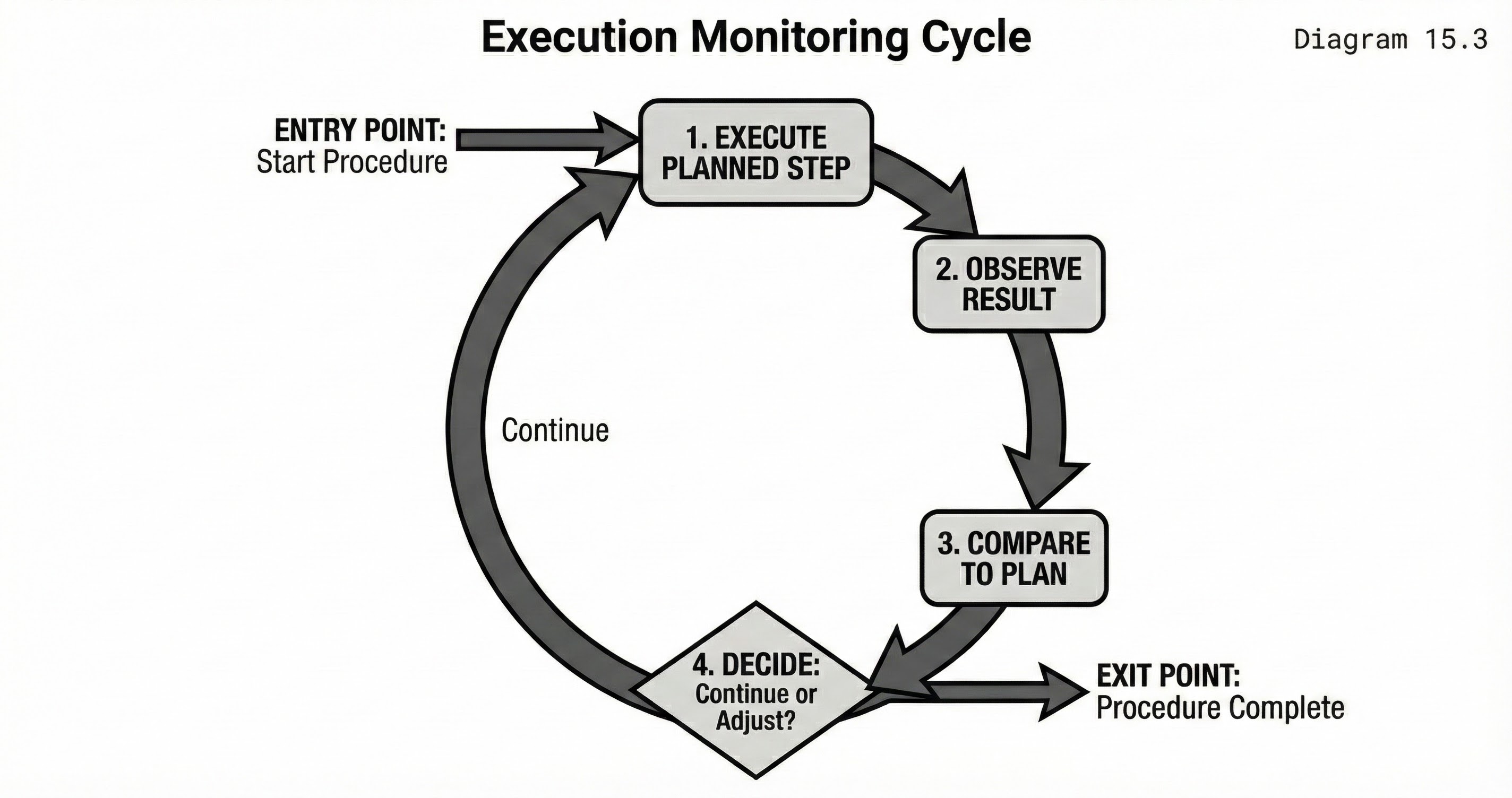
During the procedure, monitor continuously. After the first three to five strokes, pause and assess: is the tissue response matching expectations? Is the pigment sitting correctly? Is the client's emotional state manageable? At the midpoint, step back and assess the overall progress against the design intent. At the three-quarter mark, make a conscious decision about whether the remaining work should proceed as planned or whether any adjustment is needed.
Strategy Formation Process
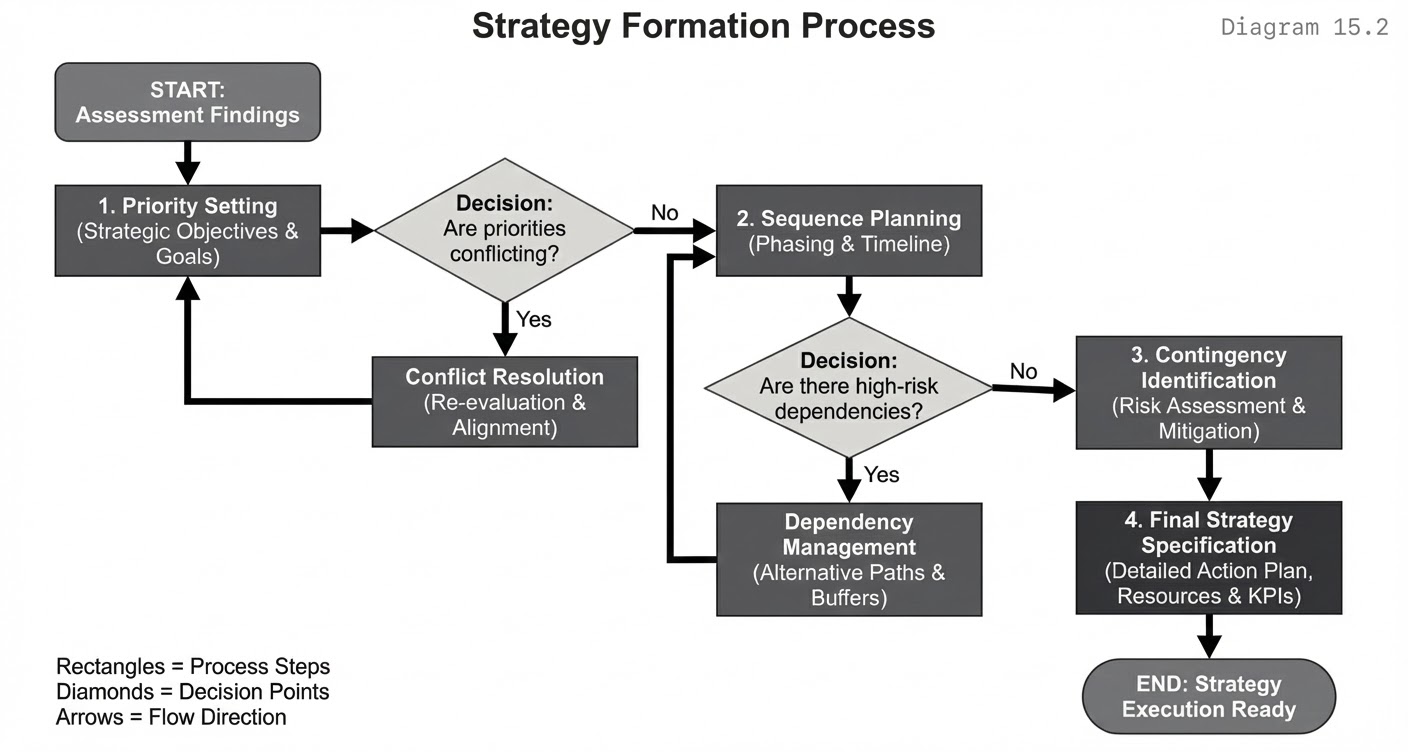
Purpose: Guide the path from findings to strategy
A flowchart showing progression from assessment findings through constraint identification, option generation, option evaluation, and strategy selection.
Post-Procedure Evaluation
After the client leaves, conduct a structured self-evaluation. What went as planned? What deviated? Why? Were the deviations improvements or compromises? What would you do differently on a similar case? This reflection, documented consistently, is the single most powerful tool for professional development. It converts experience into learning.
Techniques
Case Review
Build a library of completed cases with full documentation: assessment findings, strategy, execution notes, immediate result, healed result, client satisfaction outcome. Review these cases periodically, especially when encountering a new client who presents similarly to a past case. The ability to say "I've seen this presentation before, and here's what worked" is professional confidence built on evidence rather than ego.
Strategic Pause
At critical decision points during the procedure (blade selection, depth calibration, midpoint assessment), pause deliberately. Take five seconds to consciously assess rather than proceeding on momentum. This brief interruption prevents autopilot errors and forces active engagement with the current tissue response rather than the expected tissue response. The strategic pause is a small habit with disproportionate impact on outcome quality.
Real-Time Adaptation
When the strategy needs to change, change it deliberately rather than drifting. If the skin is responding differently than expected, stop, reassess, formulate a modified approach, then proceed with the new approach. Do not continue with a failing strategy while making incremental unconscious adjustments, because those adjustments will be inconsistent. A conscious pivot produces a coherent adapted strategy. Unconscious drift produces an incoherent mess.
Execution Monitoring Cycle
Purpose: Show the real-time adjustment process
A circular diagram showing the execute-observe-compare-decide cycle used during procedure. Each segment includes key actions and decision criteria.
Professional Notes
Case-based thinking is the hallmark of professional maturity. The novice executes technique. The competent practitioner follows protocols. The master formulates strategies. Each level subsumes the previous: the master still executes technique and follows protocols, but within the context of a strategy tailored to the specific case.
Imperfect execution of the right strategy outperforms perfect execution of the wrong strategy. A practitioner who correctly identifies that this client needs machine work rather than microblading, and executes the machine work competently, produces a better outcome than a practitioner who delivers flawless microblading on skin that was never going to retain it.
Common Mistakes
Applying the same approach to every client. This is the most fundamental strategic failure. It treats every case as if it were the same case, ignoring the variables that make each client unique. Standardised protocols have their place, but they are a starting point for adaptation, not a substitute for strategic thinking.
Failing to document and review. Without documentation, every case is experienced once and then lost. The practitioner who performs five hundred procedures without systematic documentation has one year of experience repeated five hundred times. The practitioner who documents and reviews has five hundred data points informing continuously improving strategy.
Confusing confidence with competence. The practitioner who stops questioning their approach because they "know what works" has stopped developing. Confidence should come from data (documented outcomes that confirm your approach) rather than from habit (doing it this way because you have always done it this way).
Expert Insights
The highest level of case-based execution is anticipatory strategy: identifying potential complications before they occur and building contingencies into the plan. The master practitioner, after assessing a complex case, can articulate not just what they will do but what might go wrong and how they will respond. This anticipatory thinking reduces stress during the procedure because fewer situations feel unexpected.
Professional maturity also means knowing when you are out of your depth. A case that exceeds your experience or skill level is better referred to a more experienced practitioner than attempted and botched. This is not weakness. It is the strategic thinking that this chapter advocates, applied to the most important case variable: an honest assessment of your own capabilities.
Practical Application
For your next five clients, write a one-paragraph strategy before the procedure: assessment summary, design approach, technique rationale, communication approach, contingencies. After the procedure, write a one-paragraph review: what worked, what did not, what you would change. After those five cases, review all ten paragraphs together. You will see patterns in your decision-making that are invisible in the moment but obvious in retrospect. These patterns are the raw material for strategic improvement.