Section 6: Advanced Shape Design & Aesthetic Rationale
Definition
Advanced shape design refers to the sophisticated process of determining brow architecture—the precise configuration of head, arch, tail, and internal proportions—that will optimise aesthetic outcome for a specific client. Aesthetic rationale encompasses the reasoning that connects shape decisions to desired visual effects.
At the mastery level, shape design transcends template application to become a creative and analytical synthesis of anatomical reality, aesthetic principle, and client preference.
Shape design operates at the intersection of science and art. Scientific understanding of facial structure, visual perception, and proportional relationships informs design decisions. Artistic judgment integrates these factors into cohesive designs that satisfy both technical criteria and aesthetic sensibility.
Theory
Shape theory begins with understanding how brow configuration affects facial perception. The brow frames the eye, influences perceived eye shape and size, affects apparent facial proportion, and communicates emotional disposition. Each element of brow shape—thickness, arch position, arch height, tail length, tail angle—contributes to these perceptual effects.
Thickness Theory
Thickness theory addresses the visual weight of the brow. Thicker brows command attention and create stronger facial definition; thinner brows recede and allow other features to dominate. Optimal thickness relates to facial scale, feature boldness, and stylistic goals.
Thickness distribution along the brow—typically fuller at the head, tapering toward the tail—creates natural appearance and directional flow.
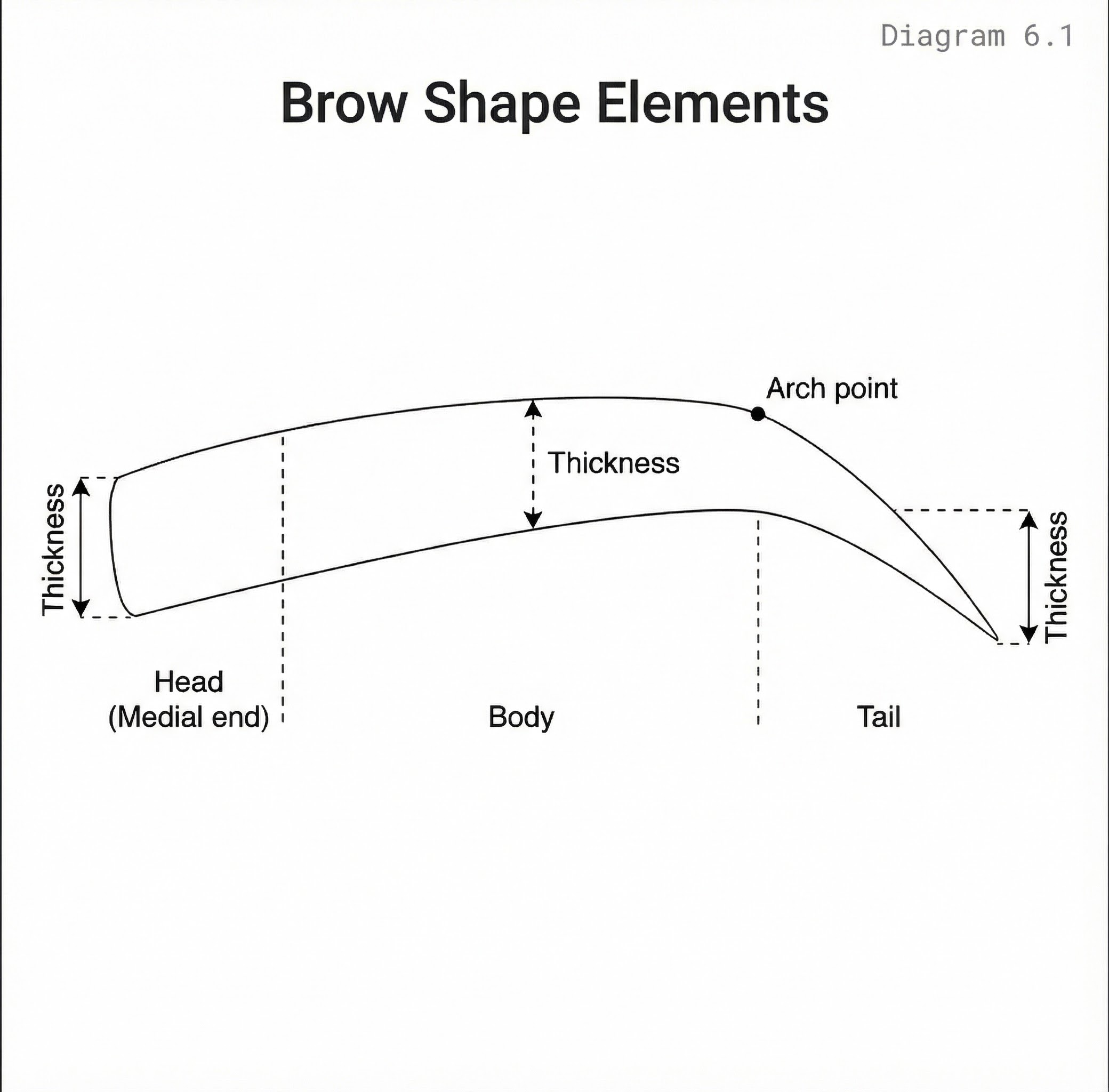
Brow Shape Elements
Purpose: Identify and label the components of brow shape
An isolated brow with labeled zones and elements: head (bulb), body, arch point, tail, upper boundary, lower boundary, thickness indicators, and directional flow arrows.
Arch Theory
Arch theory addresses the point of maximum curve and its effects on facial expression reading:
- Arch position — how far from head to tail the apex sits
- Arch height — how elevated above the brow baseline
- Arch shape — sharp versus rounded configuration
Higher arches suggest alertness or surprise; lower arches suggest calm or seriousness. Arch position relative to pupil and lateral canthus affects harmony with eye anatomy.
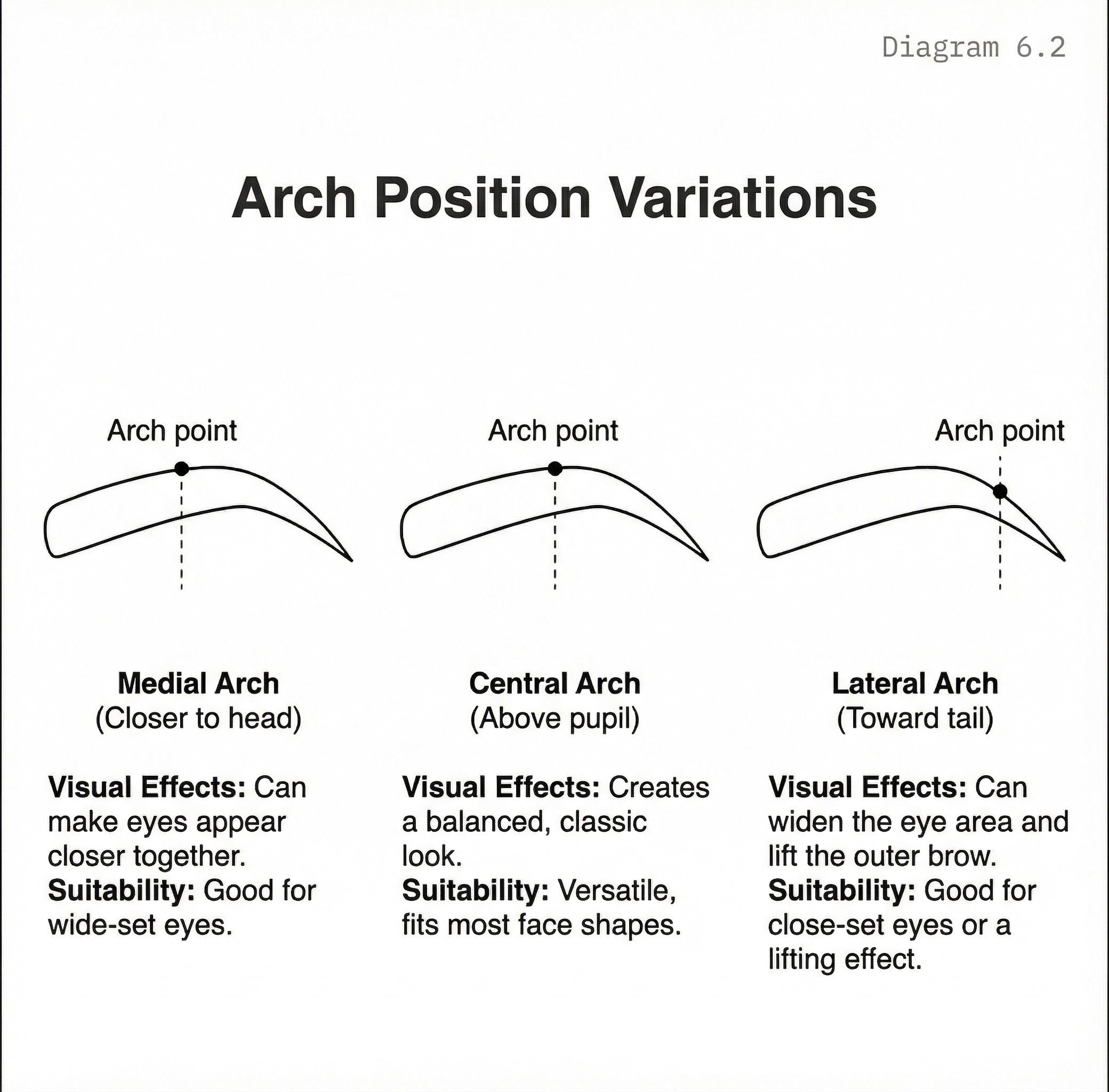
Arch Position Variations
Purpose: Show how arch placement affects brow character
Three brows with identical overall shape but different arch positions: medial arch (appearing soft/classic), central arch (balanced), lateral arch (appearing lifted/modern). Vertical lines indicate arch position.
Tail Theory
Tail theory addresses the lateral termination of the brow and its effects on eye shape perception. Tail length affects apparent eye width; longer tails elongate the eye visually. Tail angle—whether ascending, horizontal, or descending from arch—affects perceived eye lift and facial energy.
Tail endpoint position should relate to anatomical landmarks including lateral canthus and orbital rim.
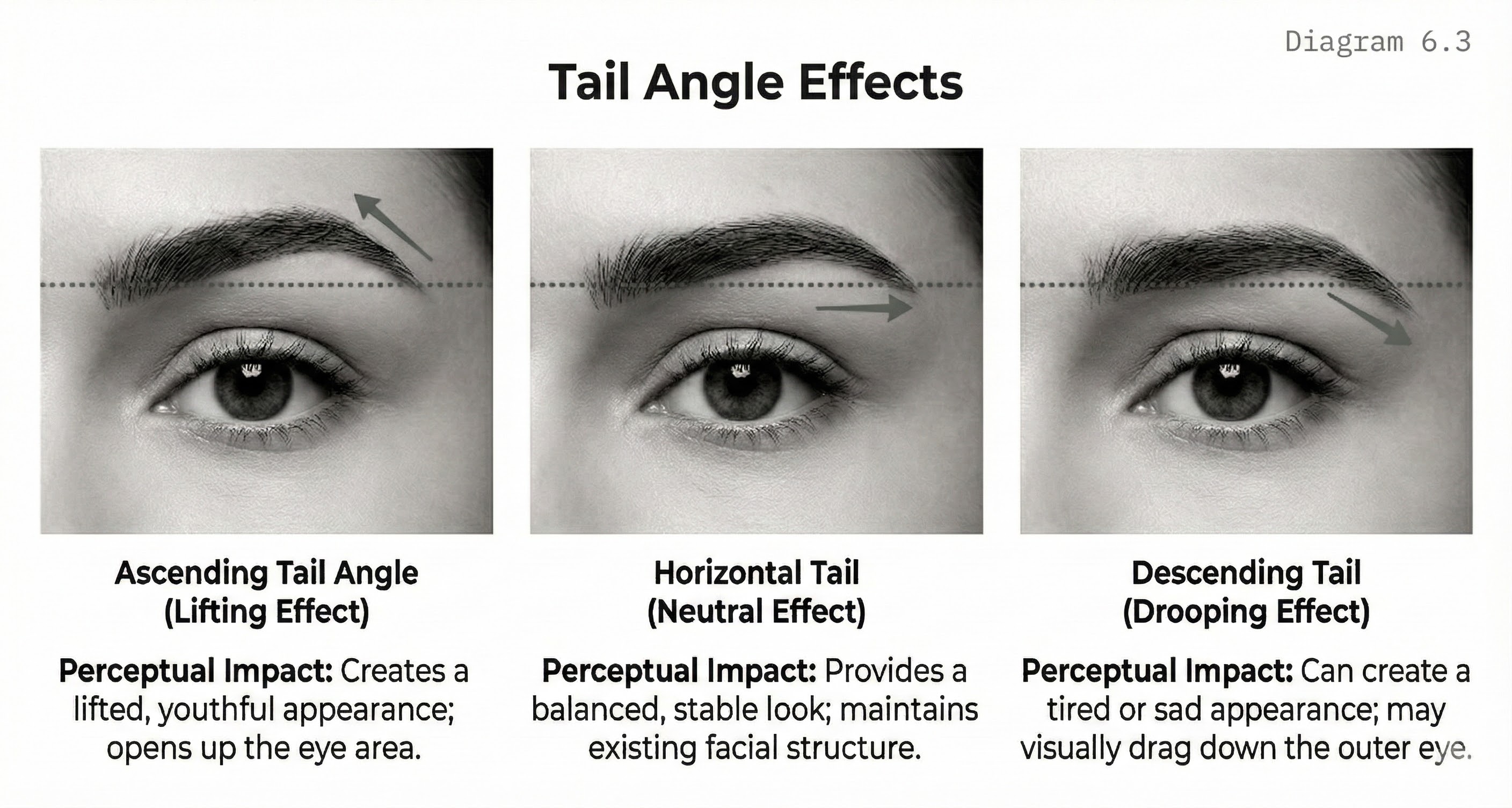
Tail Angle Effects
Purpose: Demonstrate tail trajectory impact on expression
Three brows with different tail angles: ascending tail (appearing lifted), horizontal tail (neutral), descending tail (appearing sad/aged). Angle measurements are indicated.
Integration Theory
Integration theory addresses how elements combine. Thickness, arch, and tail decisions must cohere into unified design rather than operating independently. Changes to one element affect how others read; design must consider elements in relationship rather than isolation.
Methodology
Shape design methodology integrates anatomical assessment, aesthetic analysis, and collaborative preference exploration. The process produces a customised design specification that guides execution.
Anatomical Constraint Identification
Establishes what designs are compatible with the client's structure:
- Bone mapping findings indicate where brows can optimally sit
- Muscle dynamics findings indicate how different designs will perform during expression
- Existing brow position and hair patterns constrain design possibilities
Feature Analysis
Feature analysis examines how brow design can enhance other facial features. Eye shape, size, and position inform arch placement and tail design. Forehead height and shape influence thickness and overall brow scale. Nose structure may influence medial brow design. Lip and jaw characteristics may influence overall facial proportion priorities.
Reference Development
Reference development creates visual representations of design options. Using photographs, digital manipulation, or detailed description, the practitioner develops reference points that illustrate different design directions. These references support client understanding and preference expression.
Collaborative Refinement
Collaborative refinement involves iterative discussion with the client to arrive at agreed design. The practitioner presents options with aesthetic rationale explanation. The client provides preference input. Through dialogue, a final design specification emerges that satisfies both professional judgment and client preference.
Design Documentation
Design documentation records the agreed specification in sufficient detail for execution. Key measurements, landmark references, and shape characteristics are documented. This specification guides procedure and supports outcome evaluation.
Techniques
Mapping Technique
Mapping technique translates design decisions to physical marks on the client. Using removable marking materials, the practitioner places points at key brow locations—head, apex of arch, tail endpoint—and connects them to show proposed shape. Multiple mapping options may be presented for comparison before final selection.
Digital Preview Technique
Digital preview technique uses software to visualise proposed designs on client photographs. Brow shapes can be digitally overlaid, adjusted, and compared. This provides more realistic preview than physical mapping, which occurs on the dimensional face rather than the flat photograph.
Template Reference Technique
Template reference technique uses standardised shape templates as starting points for customisation. Templates represent archetypal shapes that are then modified for individual anatomy. This approach provides structure while permitting necessary individualisation.
Comparative Technique
Comparative technique presents multiple design options for client evaluation. By seeing options in relation to each other, clients can better identify preferences. The practitioner facilitates comparison by explaining differences and likely effects.
Professional Notes
Shape design skill develops through extensive practice and critique. The practitioner who designs many brows, documents outcomes, and critically evaluates results develops increasingly refined design judgment. Peer review and mentor feedback accelerate this development.
Trend awareness informs design but should not dominate it. Shape preferences evolve with fashion; the practitioner tracks trends while maintaining focus on timeless principles and individual suitability. Design that serves the client well will outlast designs that merely follow current fashion.
Client communication regarding shape options requires balance between expertise and collaboration. The practitioner brings professional knowledge about what works; the client brings knowledge about their preferences and how they want to appear. Neither should dominate; successful design emerges from genuine collaboration.
Common Mistakes
Template Over-Reliance: Produces inappropriate designs. The practitioner who applies preferred templates without sufficient customisation ignores individual anatomy and preference. Templates should inform, not determine, design decisions.
Trend-Following Without Suitability Assessment: Produces designs that serve fashion rather than the client. Not every trendy shape suits every face; professional judgment must mediate between trend and individual appropriateness.
Client Over-Deference: Produces designs the practitioner knows to be suboptimal. The client may request shapes that professional judgment indicates will not serve them well. The practitioner should advocate for better options while respecting ultimate client authority.
Insufficient Documentation: Creates execution uncertainty. The practitioner who does not thoroughly document agreed design may struggle to execute accurately or evaluate outcomes meaningfully.
Expert Insights
Master designers develop intuitive shape sense—the capacity to envision optimal design upon first seeing a face. This intuition emerges from extensive experience and should be trusted while remaining open to refinement through systematic analysis.
The best designs often involve restraint. The temptation to demonstrate capability through elaborate design should be resisted when simpler design better serves the client. Excellence sometimes means doing less rather than more.
Design flexibility must extend through procedure execution. Even well-planned designs may require adjustment as execution reveals tissue response or other factors not apparent during planning. The master designer maintains adaptability rather than rigid adherence to pre-procedure specification.
Practical Application
Shape design consultation should allocate sufficient time for comprehensive process completion. Rushing design compromises quality; the practitioner schedules consultation time that permits thorough anatomical assessment, option development, and collaborative refinement.
Design documentation becomes part of the permanent client record. Specifications, reference images, and any digital previews are retained for future reference. This documentation supports both outcome evaluation and future procedure planning.
Post-procedure design evaluation compares executed outcome to design specification. Where deviations occurred, the practitioner analyses causes and documents learnings for future reference. This systematic evaluation supports continuous improvement in design-to-execution accuracy.