Section 9: Advanced Hair Flow Engineering & Brow Patterning
Definition
Hair flow engineering refers to the strategic design and execution of stroke patterns that replicate natural hair growth direction, density variation, and dimensional layering. Brow patterning encompasses the overall organisation of strokes into cohesive designs that integrate naturally with existing hair and skin characteristics.
At the mastery level, hair flow engineering produces results that are indistinguishable from natural hair growth under normal observation.
Natural brows exhibit complex patterning that develops from embryonic hair follicle positioning and subsequent growth direction establishment. Artificial replication of this complexity requires both understanding of natural patterns and technical capacity to execute intricate stroke arrangements.
Theory
Natural Growth Pattern Theory
Natural growth pattern theory describes how brow hairs typically organise:
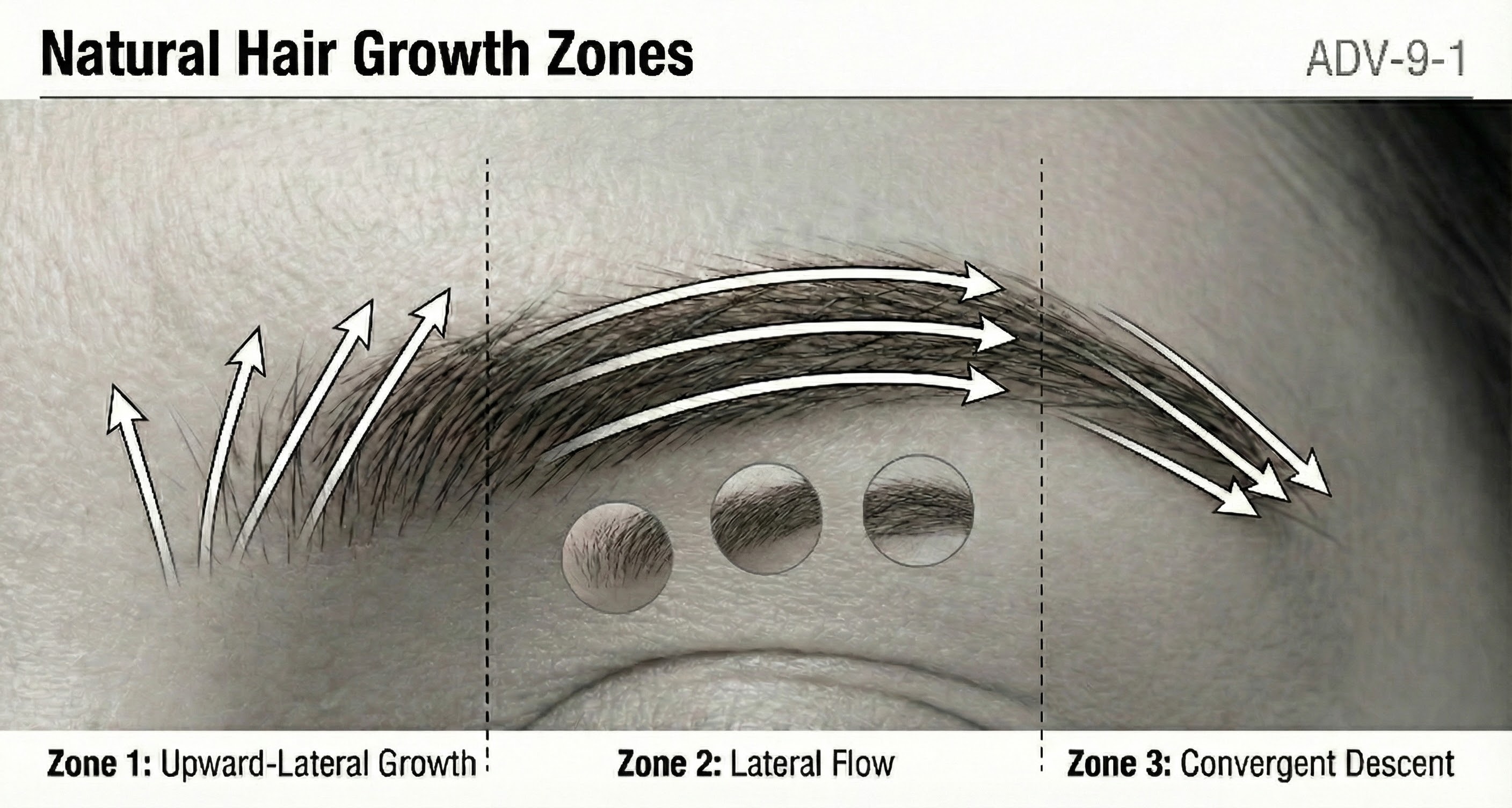
- Head region — typically shows upward and slightly lateral growth
- Body region — transitions to more horizontal growth with continued lateral direction
- Arch region — may show upward or crossed patterns depending on individual growth
- Tail — typically shows downward-angled growth following the natural tail descent
Natural Hair Growth Zones
Purpose: Map natural directional patterns across the brow
A brow divided into zones with directional arrows showing natural hair growth patterns. Zone 1 (head) shows upward/slightly lateral direction. Zone 2 (body) shows lateral flow. Zone 3 (tail) shows downward/lateral convergence.
Pattern Variation Theory
Pattern variation theory recognises that natural growth patterns vary significantly across individuals. Some brows show orderly, predictable patterns; others show irregular growth with multiple directions within zones. Ethnic variation, hormonal influence, and individual development all contribute to pattern diversity.
Density Distribution Theory
Density distribution theory addresses how natural brows vary in hair density across their extent:
- The head typically shows moderate density with sparser appearance due to upward hair direction
- The body typically shows highest density with most compact appearance
- The arch may show slight thinning
- The tail tapers to lower density toward termination
Dimensional Layering Theory
Dimensional layering theory describes how natural hairs overlap to create three-dimensional depth. Shorter hairs provide base layer; longer hairs cross over base layer creating depth effect. This layering produces richness that single-layer stroke patterns cannot achieve.
Methodology
Pattern Analysis Methodology
Pattern analysis methodology examines the client's natural hair growth to identify directions, density distribution, and any pattern irregularities. This analysis guides stroke design that will integrate with existing hair.
Zone Mapping Methodology
Zone mapping methodology divides the brow into regions for differential stroke treatment. The head zone, body zone, arch zone, and tail zone each receive stroke patterns appropriate to their characteristic growth directions and densities.
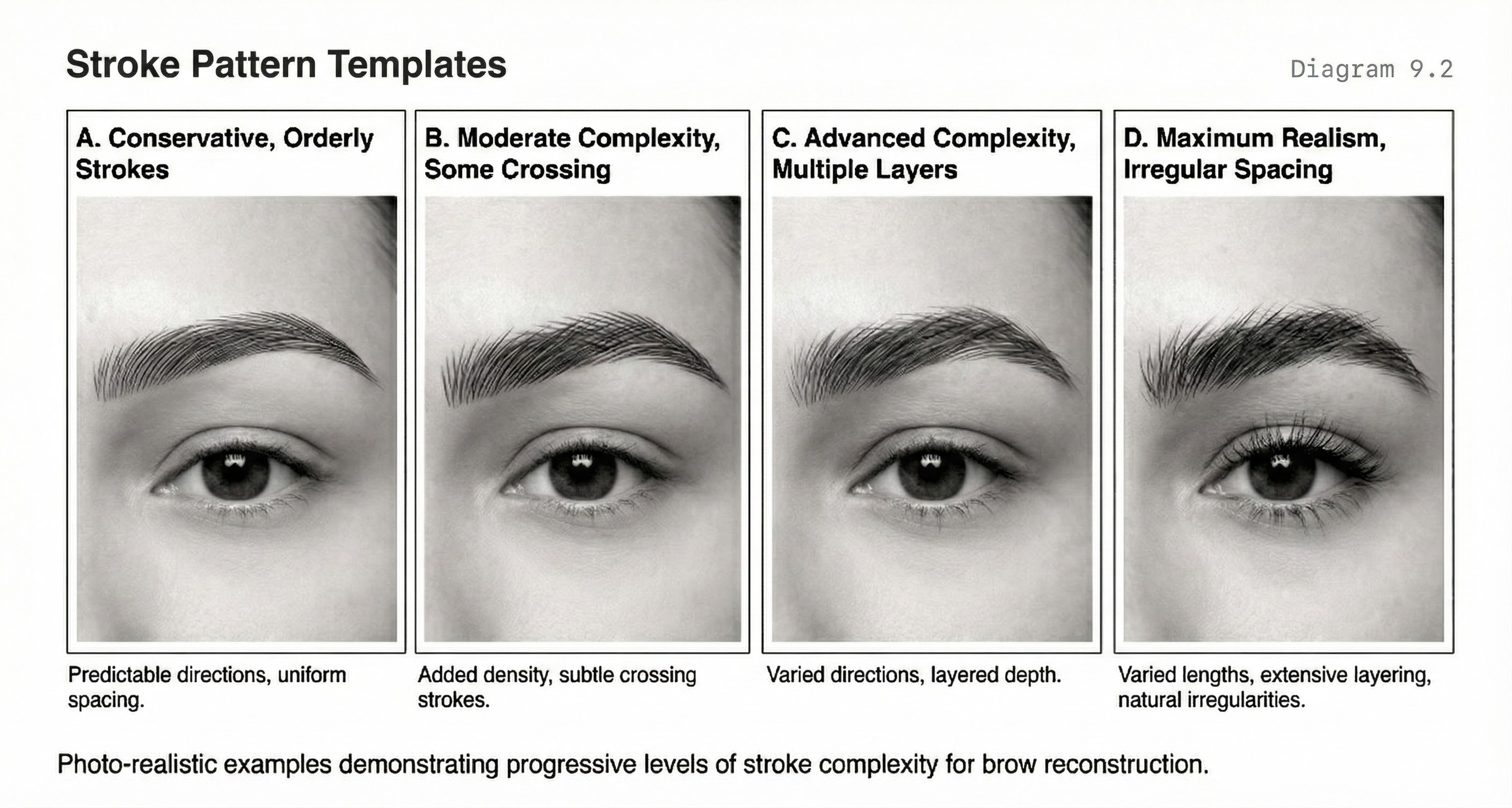
Stroke Pattern Templates
Purpose: Provide pattern references for different complexity levels
Four brows showing progressive stroke pattern complexity: basic (single layer, uniform direction), intermediate (varied angles), advanced (multiple layers), and complex (full dimensional layering).
Stroke Planning Methodology
Stroke planning methodology designs specific stroke placements before execution. The practitioner determines stroke angles, lengths, and spacing for each zone, creating a mental or documented map that guides execution.
Integration Methodology
Integration methodology addresses how artificial strokes will blend with existing natural hair. Where natural hair exists, artificial strokes must follow the same directions and appear to emerge from the same follicular pattern. Where no natural hair exists, strokes must create convincing illusion of hair growth without natural reference.
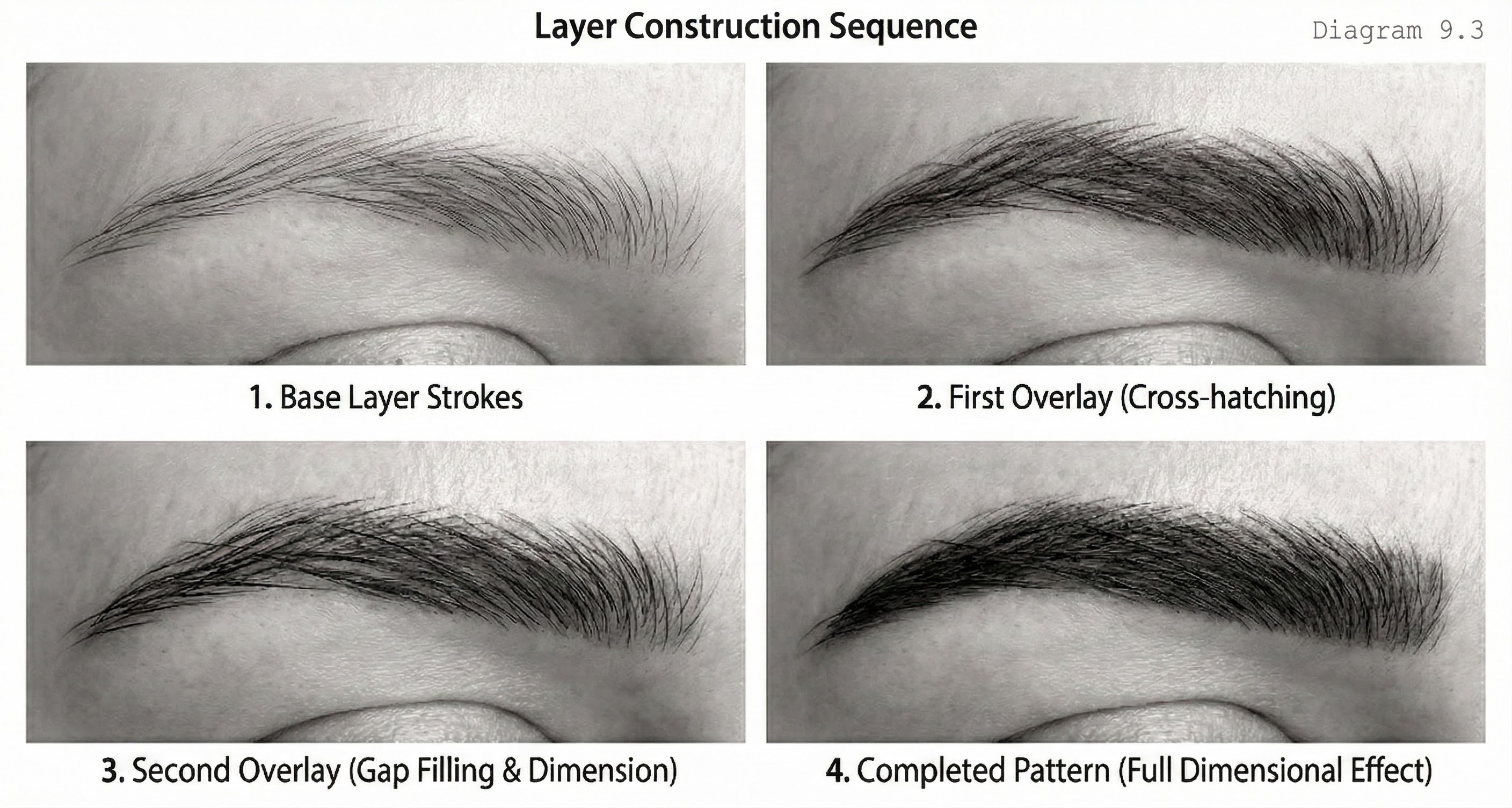
Layer Construction Sequence
Purpose: Show systematic layer building approach
A four-panel progression showing layer construction: Panel 1 shows base layer strokes, Panel 2 adds secondary directional layer, Panel 3 adds dimensional detail strokes, Panel 4 shows completed multi-layer pattern.
Techniques
Direction Technique
Direction technique controls stroke angle to match natural growth direction at each brow location. The practitioner adjusts hand position and blade angle to create strokes following the appropriate direction for each zone.
Length Variation Technique
Length variation technique creates strokes of different lengths to replicate natural hair variation. Longer strokes and shorter strokes intermix to avoid the artificial uniformity of identical stroke lengths.
Spacing Technique
Spacing technique controls distance between strokes to achieve appropriate density. Closer spacing creates denser appearance; wider spacing creates lighter appearance. Spacing varies across brow zones to replicate natural density distribution.
Layering Technique
Layering technique applies strokes in multiple passes with different directions to create dimensional depth. Base layer strokes establish foundation; overlay strokes cross base layer to create the woven appearance of natural hair overlap.
Feathering Technique
Feathering technique softens transitions between zones and between worked and unworked areas. Graduated density at boundaries prevents harsh demarcation and creates natural blending.
Professional Notes
Hair flow mastery requires extensive practice on practice media before client application. The motor patterns for precise directional control develop through repetition; attempting complex patterning without sufficient practice foundation produces poor results.
Natural variation in growth patterns means that no single pattern formula applies universally. The practitioner must read each client's natural pattern and design accordingly rather than applying standardised stroke arrangements.
Pattern decisions are difficult to change once executed. Unlike colour, which can be adjusted in subsequent sessions, stroke placement is permanent within each application. Careful planning before execution prevents pattern errors.
Common Mistakes
Uniform Stroke Direction: Creates artificial appearance. Natural brows show directional variation; strokes all following identical angles read as obviously artificial. Appropriate variation produces realistic results.
Equal Stroke Spacing: Produces mechanical appearance. Natural hair spacing varies; regular grid-like stroke spacing reads as manufactured. Irregular spacing with natural clustering produces realism.
Insufficient Density: Fails to create the visual weight of natural brow. The practitioner may apply too few strokes from caution; the result appears sparse and incomplete. Adequate density requires sufficient stroke numbers.
Excessive Density: Creates overly dark, solid appearance. Too many strokes too closely spaced loses the hair-like quality; the result appears filled rather than hair-stroked. Appropriate spacing maintains hair-like openness.
Expert Insights
Master practitioners develop personal pattern styles that become signatures of their work. While always respecting natural growth logic, each master develops characteristic approaches to layering, spacing, and directional variation.
The most realistic patterns often involve deliberate imperfection.Perfect symmetry and regularity appear artificial; slight irregularities and asymmetries create convincing naturalism.
Pattern complexity should match client characteristics and preferences. Some clients want obvious enhancement; others want invisible correction. Pattern approach should serve client goals rather than demonstrate practitioner capability.
Practical Application
Pattern planning occurs after shape design is finalised. With the brow outline established, the practitioner develops the stroke pattern that will fill the design.
Execution follows planned pattern while remaining responsive to how strokes actually appear during application. If planned pattern is not achieving desired effect, adjustment occurs in real-time.
Outcome evaluation specifically assesses pattern quality—direction appropriateness, density distribution, dimensional effect, integration with natural hair. Pattern refinement in touch-up sessions addresses any areas requiring improvement.