Section App. 14: Advanced Client Management, Behaviour & Psychology
Definition
Advanced client management is the ability to read, respond to, and guide client behaviour throughout the service relationship. At this level, the practitioner is managing not just technical outcomes but psychological ones: expectations, anxieties, decision-making patterns, and satisfaction drivers that exist independently of the quality of the work itself.
A technically perfect result on an emotionally mismanaged client is a failure. The client who received excellent work but felt unheard, rushed, or surprised by the healing process will leave negative reviews, will not return, and will not refer. The client who received good (not perfect) work but felt deeply understood and well-prepared throughout will become an advocate. Psychology determines business outcomes more reliably than technique.
Theory
Expectation Formation
Clients arrive with expectations formed before they enter your studio. These expectations come from social media (heavily filtered, often unrealistic), from previous experiences (positive or traumatic), from friends' results (which may have been on entirely different skin types), and from their own self-image (which may or may not align with what is achievable). Your first task is to understand these pre-formed expectations before attempting to reshape them.
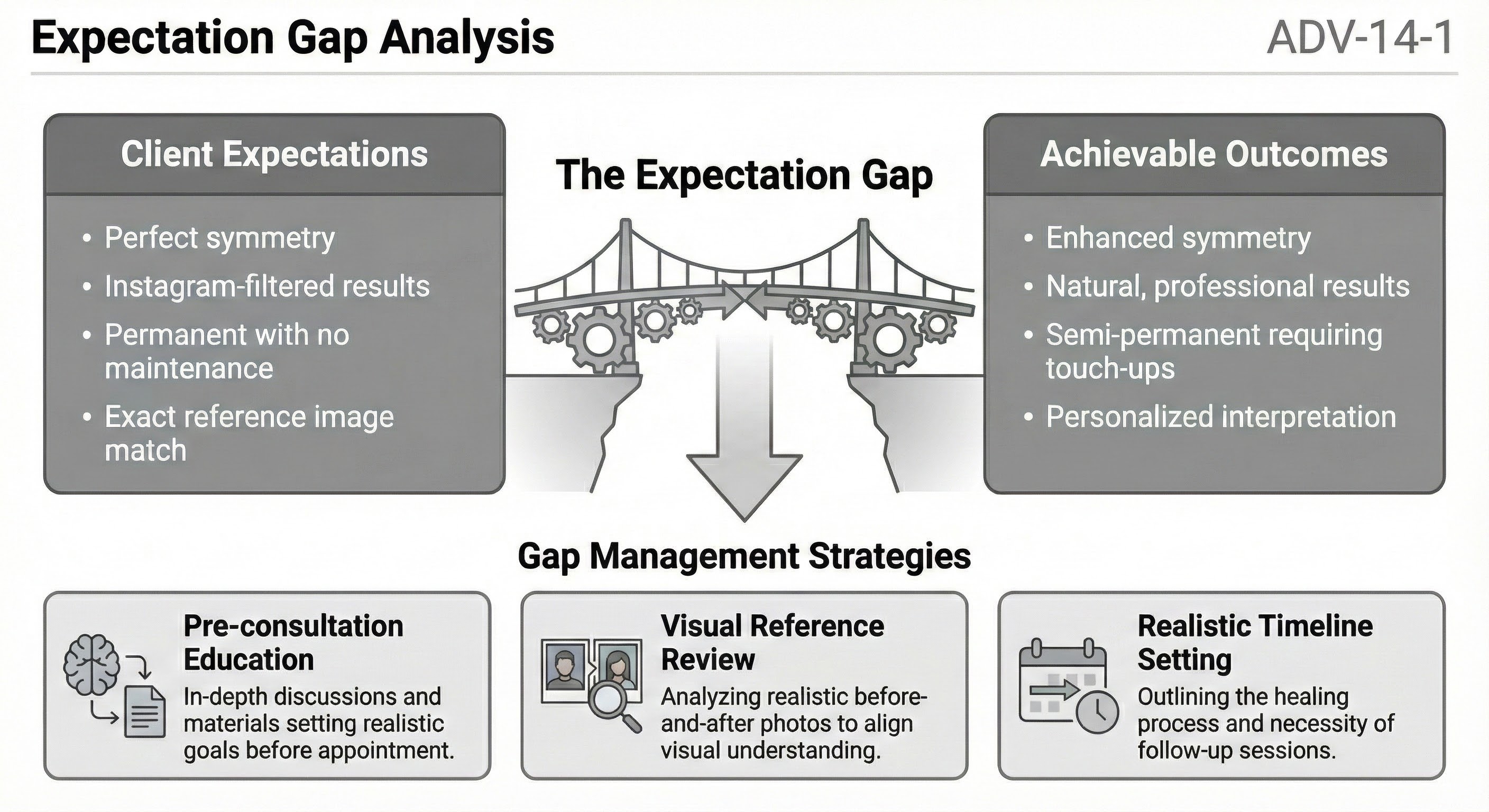
Expectation gaps create dissatisfaction. The client who expects to look like a filtered Instagram photo will be disappointed by a technically excellent natural result. The client who expects microblading to be painless because a friend said it was will be distressed by normal discomfort. The client who expects the healed result to look identical to the fresh result will panic during the ghosting phase. Identifying and closing these gaps during the consultation prevents problems that no amount of technical skill can fix after the fact.
Expectation Gap Analysis
Purpose: Visualise the gap between expectation and achievable outcome
A diagram showing client expectations on one side and achievable outcomes on the other, with the gap between them highlighted. Strategies for bridging or addressing the gap are indicated.
Decision Psychology
Permanent makeup is a high-stakes decision for the client. Unlike a haircut or a facial, the result persists for months or years. This creates a specific psychological dynamic: heightened anxiety, increased scrutiny of the practitioner's competence, and a need for reassurance that is disproportionate to the medical risk involved. Understanding that you are managing a perceived risk, not just a cosmetic procedure, changes how you approach the entire client relationship.
Decision fatigue affects consultations. Clients who are asked to make too many choices (this shape or that shape? this colour or that colour? this technique or that technique?) become overwhelmed and either disengage ("just do what you think is best") or become paralysed with indecision. The skilled practitioner presents a recommended plan with clear reasoning, then invites the client to modify specific elements rather than building the entire plan from scratch through client choices.
Anxiety Patterns
Client anxiety follows predictable patterns across the service lifecycle. Pre-procedure anxiety peaks during the consultation when the decision feels imminent. During the procedure, anxiety typically drops as the client surrenders control (though it may spike if they look in a mirror too early). Post-procedure anxiety builds gradually, peaking between days 5 and 10 when the healing process looks most alarming. A secondary anxiety peak occurs at weeks 3 to 4 when the ghosting phase makes the result look faded.
Knowing when anxiety peaks allows proactive management. A calm, detailed consultation reduces pre-procedure anxiety. Narrating what you are doing during the procedure reduces procedural anxiety. A scheduled check-in message at day 5 catches the first healing anxiety peak. A second check-in at week 3 catches the ghosting anxiety. Each proactive contact prevents a reactive crisis.
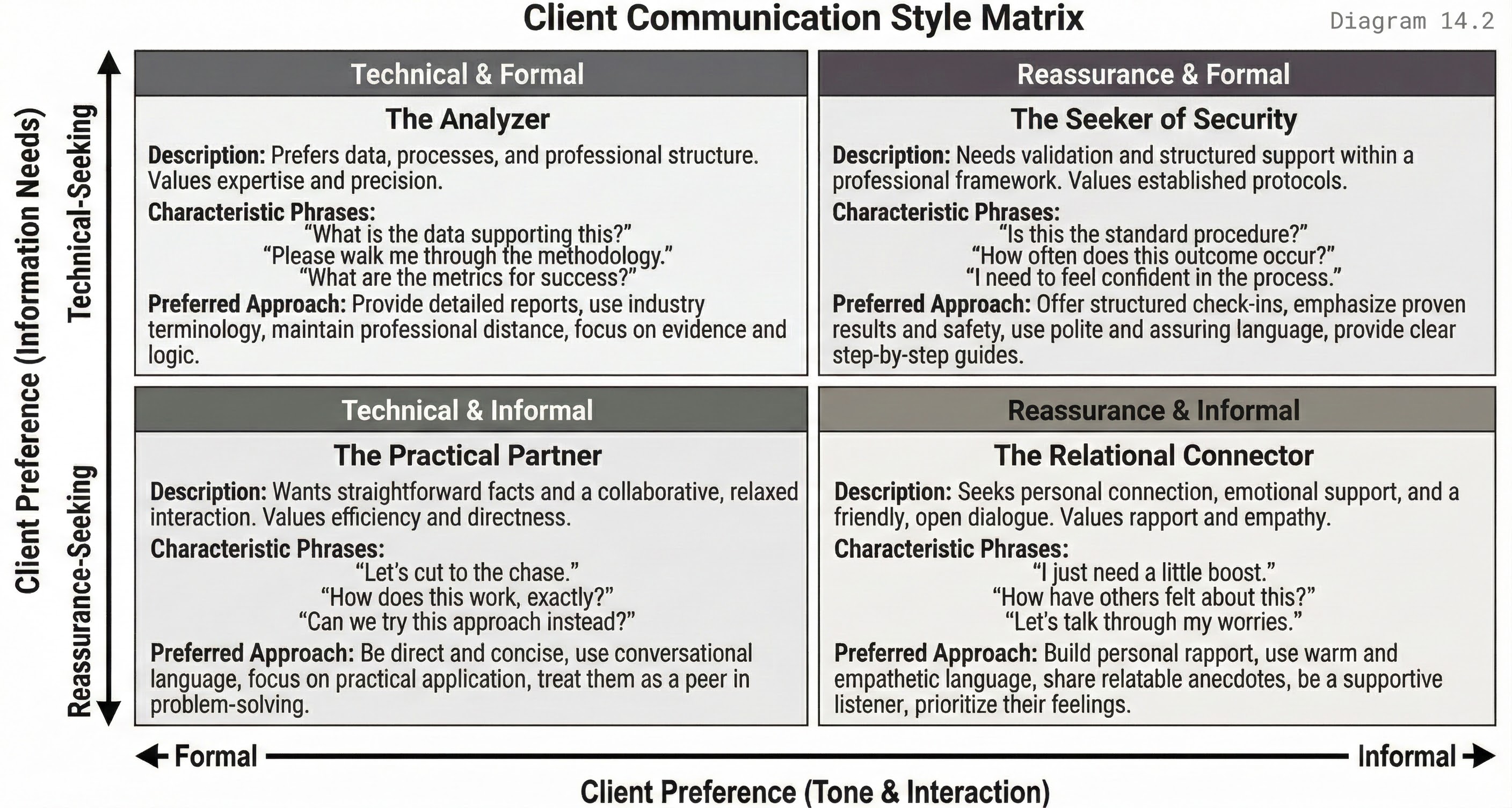
Client Communication Style Matrix
Purpose: Match communication approach to client type
A grid with communication style (technical vs. reassurance-focused) on one axis and formality (formal vs. casual) on the other. Client types are positioned within the grid with appropriate approach notes.
Methodology
Expectation Assessment
During the consultation, explicitly explore what the client expects. Ask what they hope the result will look like, how they expect the procedure to feel, and what they understand about healing. Listen for gaps between their expectations and reality. When you identify a gap, close it before proceeding: "I want to make sure we're aligned. The healed result will be softer and lighter than what you'll see today. Here's what that looks like..." and show healing progression photographs.
Communication Adaptation
Different clients need different communication approaches. The analytical client wants data: healing timelines, percentage retention estimates, technical explanations. The anxious client wants reassurance: "This is completely normal, here's why, here's what happens next." The trusting client wants minimal explanation and maximum efficiency. The sceptical client wants evidence: before-and-after photographs, credentials, testimonials. Read the client's communication style in the first minutes of the consultation and adapt your approach accordingly.
Difficult Conversation Management
Some consultations require difficult conversations. The client whose expectations are unrealistic needs to hear that clearly but compassionately. The client with a previous bad result needs to hear an honest assessment of what can and cannot be corrected. The client who wants a trend that will not suit their face needs to understand why you are recommending something different. These conversations are uncomfortable but essential. Avoiding them to keep the client happy in the moment creates problems that are much harder to resolve after the procedure.
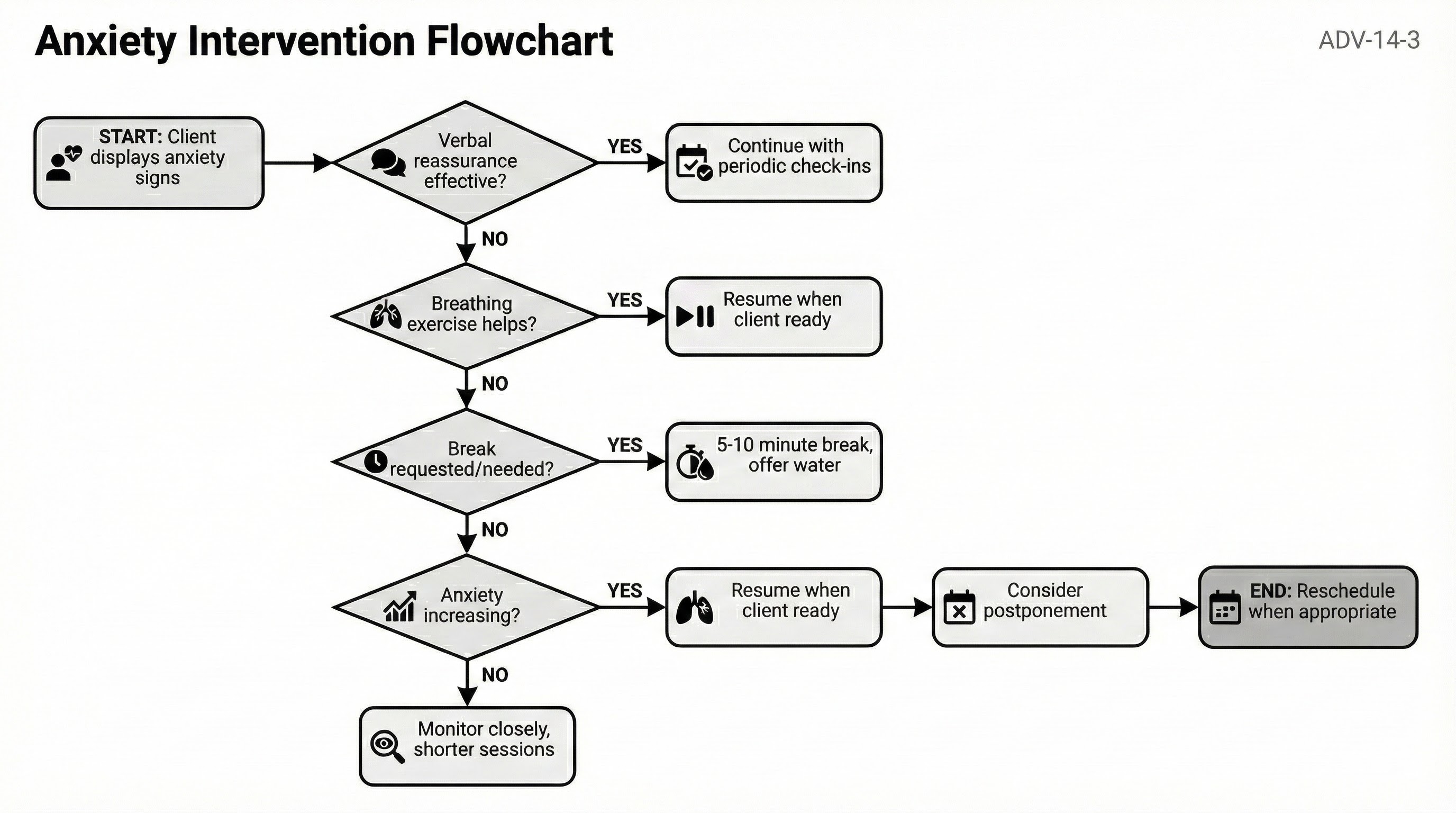
Anxiety Intervention Flowchart
Purpose: Guide response to client anxiety
A decision tree for managing anxious clients. Starting with anxiety recognition, branches lead through severity assessment, intervention options, and decision points about proceeding or postponing.
Techniques
Expectation Calibration
Show, do not tell. Verbal descriptions of healed results are imprecise and subject to interpretation. Visual references are concrete. Build a portfolio of healing progression images across different skin types and techniques. During the consultation, show the client images of cases similar to theirs: "Here's a client with a similar skin type. This is day one, day seven, and six weeks. This is what you should expect."
Active Listening
Active listening is not silence while the client speaks. It is demonstrating that you have heard, understood, and integrated what they said. Reflect back key points: "So your main priority is a natural look, and you're specifically concerned about the inner corners looking too harsh." This confirmation serves two purposes: it ensures you have understood correctly, and it shows the client they have been heard, which reduces anxiety more effectively than any amount of technical reassurance.
Boundary Setting
Professional boundaries protect both the practitioner and the client. The client who wants to direct every stroke, who brings fifteen reference photos and wants elements from each, or who changes their mind repeatedly during the procedure, is not being difficult. They are anxious and attempting to manage that anxiety through control. Acknowledge the anxiety, then set clear boundaries: "I understand you want to be involved in the process, and I appreciate that. Here's how we can work together most effectively..." Boundaries set with empathy are received better than boundaries set with authority.
Professional Notes
Client satisfaction is not binary. Research consistently shows that satisfaction with cosmetic procedures is determined by four factors in roughly this order: whether the client felt heard and respected, whether expectations were accurately set, whether the result met those expectations, and whether the overall experience felt professional. Note that the technical result is third on this list, not first. This is not to diminish the importance of technical excellence, but to highlight that it is insufficient on its own.
The most dangerous client is the one who says nothing.The client who expresses concerns gives you the opportunity to address them. The client who smiles, says everything is fine, and then leaves a negative review online gave you no opportunity to intervene. Actively invite feedback and concerns at every stage. Make it safe for the client to express doubt.
Common Mistakes
Assuming technical excellence equals client satisfaction.The practitioner who focuses exclusively on the quality of the strokes while ignoring the client's emotional state during the process is solving the wrong problem. Excellent work on an anxious, unheard client produces dissatisfied clients.
Avoiding difficult conversations. Agreeing to unrealistic expectations to avoid conflict creates a guaranteed dissatisfied client. The discomfort of a frank consultation conversation is always less than the discomfort of a disappointed client at follow-up.
Reactive rather than proactive communication. Waiting for the panicked day-seven text and then responding is damage control. Sending a proactive day-five message ("How are your brows healing? Remember, this is the phase where they may look patchy, and that's completely normal") prevents the panic entirely.
Expert Insights
Experienced practitioners develop the ability to identify high-risk clients during the consultation. The client with highly specific, inflexible expectations. The client who has had multiple procedures with multiple practitioners and was dissatisfied each time. The client who expresses distrust of the process while still wanting to proceed. These clients require either additional expectation management or, in some cases, a respectful decline. The ability to say "I don't think I'm the right practitioner for what you're looking for" is a professional skill, not a failure.
Practical Application
Develop a structured consultation framework that explicitly addresses expectations, healing education, and communication preferences. Build a visual portfolio organised by skin type and technique. Implement proactive check-ins at days 3, 7, and weeks 3 and 6. After each client, note what communication approach worked and what could be improved. Client management is a skill that develops through deliberate reflection, not through volume alone.